
Description
5 Powerful Reasons to Choose the Ultimate Alpsolar 11kW Solar Inverter at ₦1,050,000
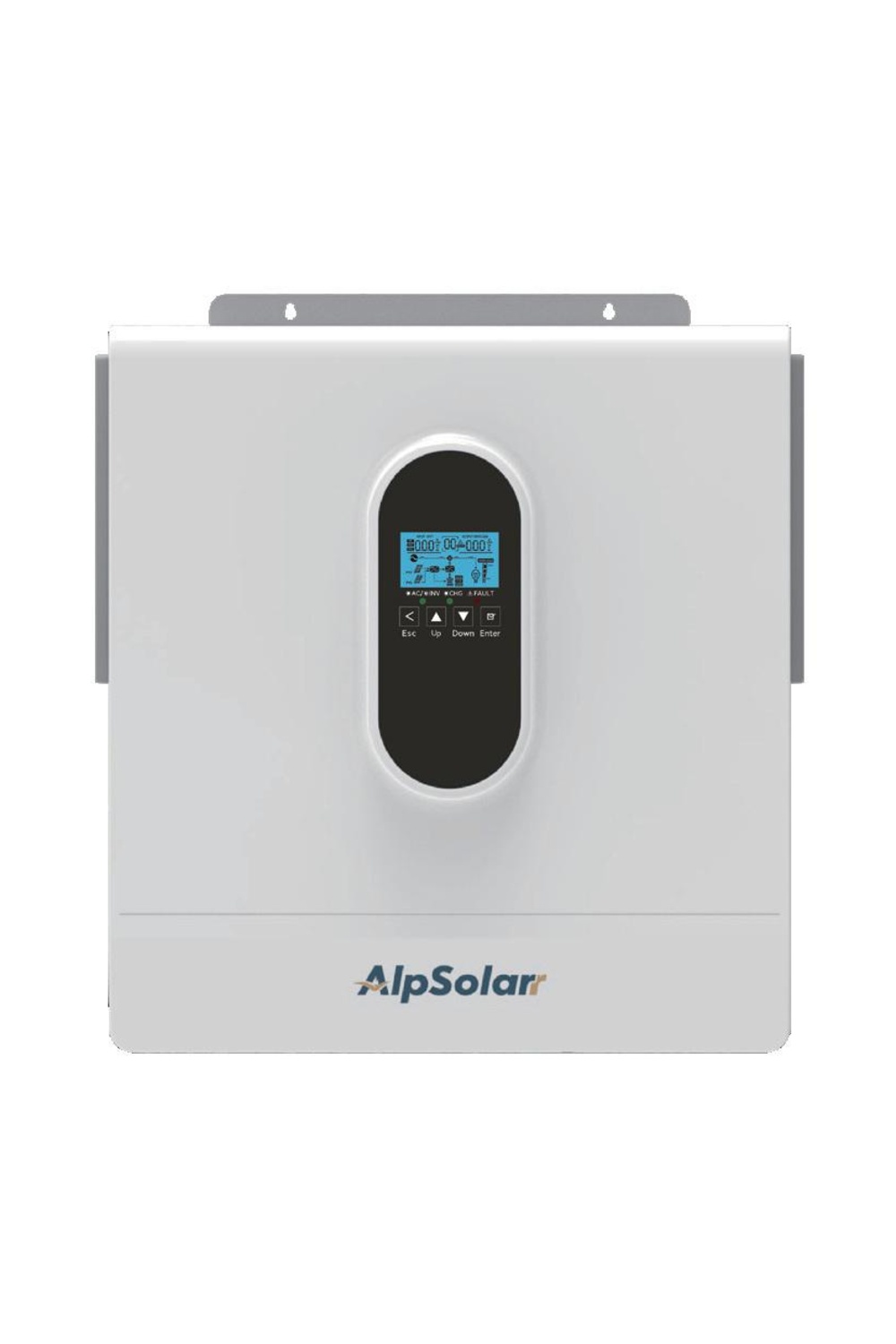
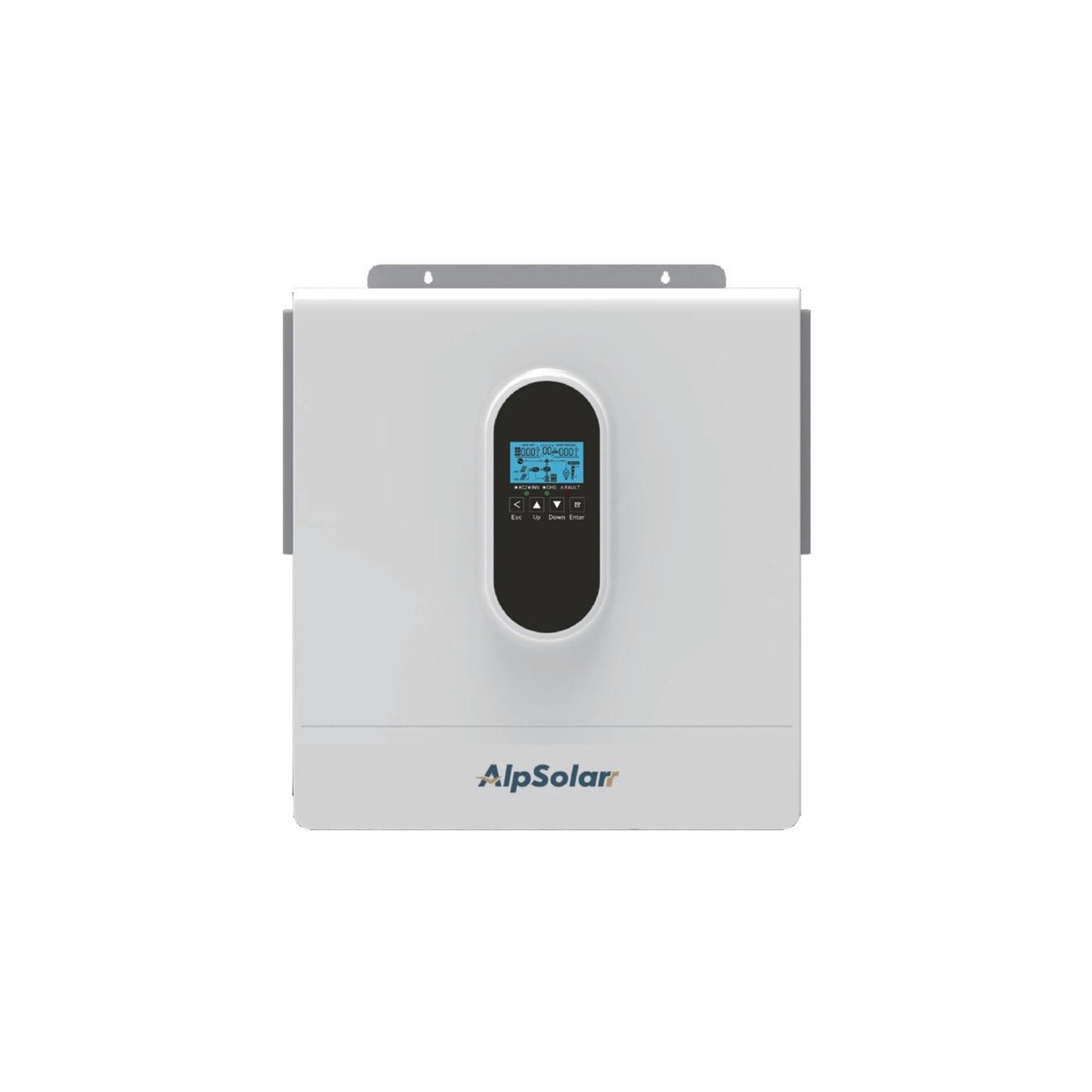
Quick Answer: The Alpsolar Pulse S2 is an 11kW, 48V hybrid solar inverter priced at ₦1,050,000 in Nigeria, down from ₦1,200,000. It offers dual MPPT inputs, 97% peak efficiency, and 10ms switching.
It suits large homes, offices, clinics, hotels, and small factories.
A reliable solar inverter is the heart of any serious solar system. I have spoken with many facility managers across Lagos, Abuja, and Port Harcourt.
Almost all of them describe the same problem. Their grid supply is unpredictable, and their diesel bills keep climbing.
Panels get most of the attention. The solar inverter does the real work. It converts DC power into clean AC power, and it decides when to draw from solar, battery, grid, or generator.
In this guide, I explain the Alpsolar Pulse S2 11kW in plain language. You will see the specs, the real costs, and the payback maths. I will also tell you when a smaller unit makes more sense.
Why Grid Instability Makes a Heavy-Duty Solar Inverter Essential
Nigeria’s grid is classified into service bands. The Nigerian Electricity Regulatory Commission explains this in its service-based tariff guide. Each band promises a minimum number of daily supply hours.
The table below shows what each band is supposed to deliver.
| Service Band | Minimum Daily Supply | What It Means for Your Business |
|---|---|---|
| Band A | 20 hours | Best supply, highest tariff |
| Band B | 16 hours | Four to eight hours of backup needed |
| Band C | 12 hours | Half of every day without grid power |
| Band D | 8 hours | Backup power becomes your main supply |
| Band E | 4 hours | The grid is a bonus, not a source |
Band A customers currently pay about ₦209.50 per kWh, according to NERC officials. That is a premium price for supply that often falls short. Reports from Lagos, Abuja, and Port Harcourt show many feeders missing their promised hours.
I have noticed that reality rarely matches the regulatory promise. A business in Band B or Band C still loses hours of production every day. A heavy-duty solar inverter closes that gap.
Voltage swings add a second problem. Sudden spikes and sags damage compressors, servers, and motors. A good solar inverter isolates your equipment from those swings and keeps clean power flowing.
Reason 1: 11,000W of Continuous Output for Real Commercial Loads
The Alpsolar Pulse S2 delivers 11,000W of rated output power. Its rated output current is 48A. That is enough for a large home, a busy office, or a small clinic.
Many buyers underestimate their real load. So let me show you a realistic example.
What Can an 11kW Solar Inverter Actually Run?
The table below lists a typical medium office or large home. The wattages are approximate, and your equipment may differ.
| Appliance | Approximate Wattage | Quantity | Total Watts |
|---|---|---|---|
| 1.5HP inverter air conditioner | 1,200W | 3 | 3,600W |
| Deep freezer | 250W | 1 | 250W |
| Refrigerator | 150W | 1 | 150W |
| 1HP borehole pump (running) | 750W | 1 | 750W |
| Desktop computers | 65W | 10 | 650W |
| LED lighting points | 10W | 40 | 400W |
| Network rack and router | 300W | 1 | 300W |
| Printer and photocopier | 800W | 1 | 800W |
| Total | 6,900W |
This load uses about 63% of the inverter’s rated capacity. That is a healthy operating range. It leaves room for motor startup surges and future additions.
Why Headroom Matters
Motors draw a large surge when they start. A pump or compressor can pull several times its running wattage for a second or two. An undersized solar inverter trips or shuts down under that stress.
I recommend keeping your continuous load below 70% to 80% of the rated output. This protects the hardware and extends its life. It also gives you space to add another air conditioner next year.
To see how system size drives price, read our guide to the cost of solar power in Nigeria.
Reason 2: Dual MPPT Technology That Squeezes More From Your Panels
MPPT stands for Maximum Power Point Tracking. It is the part of a solar inverter that finds the best voltage and current from your panels. Sunlight changes all day, and the MPPT adjusts continuously.
The Pulse S2 has two independent MPPT trackers. Each tracker handles two strings of panels. This matters when your roof faces more than one direction.
Consider a building with panels on an east roof and a west roof. One tracker manages the morning-facing panels. The other manages the afternoon-facing panels. Neither side drags the other down.
Solar Input Specifications
| PV Specification | Value |
|---|---|
| Maximum PV input power | 2 x 8,250W |
| Maximum PV voltage | 500V |
| MPPT voltage range | 60V to 450V |
| Number of MPPT trackers | 2 |
| Strings per MPPT | 2 |
| Maximum current per MPPT | 27A |
How Many Panels Can You Connect?
The maximum PV input is 16,500W across both trackers. A practical array is usually 12kW to 15kW. That is roughly 20 to 24 panels of 620W each.
The Trina 620W Vertex N Shield panel is a strong match for this inverter. It is currently listed at ₦133,000. Twenty of them give you a 12.4kW array.
Your installer must check panel voltage against the 500V ceiling. Cold mornings raise panel voltage, so the calculation needs a safety margin. Never guess this number.
You can compare panel options in our guide to the cost of solar panels in Nigeria.
Reason 3: Lithium and Lead-Acid Battery Compatibility
A solar inverter is only as useful as the battery it controls. The Pulse S2 works with both lithium-ion and lead-acid batteries. The system voltage is 48V, and the accepted range is 40V to 60V.
Lithium is the better choice for most buyers. It gives deeper usable capacity and far more charge cycles. Lead-acid is cheaper upfront but wears out quickly in Nigerian heat.
Battery Charge and Discharge Limits
| Battery Specification | Value |
|---|---|
| Battery type | Lithium-ion and lead-acid |
| Nominal voltage | 48V |
| Voltage range | 40V to 60V |
| Maximum charge current | 150A |
| Maximum discharge current | 220A |
Here is what those numbers mean in practice. At 48V, a 220A discharge supports roughly 10.5kW from the battery alone. A 150A charge current allows about 7.2kW of charging.
Your battery must be able to match those currents. A weak battery limits the whole system. A single HiTHIUM 16kWh lithium battery rated at 200A can carry most loads on this inverter.
The Pulse S2 is compatible with LiFePO4 banks from HiTHIUM, Deye, Leoch, and other brands. Always confirm communication settings before purchase. Your installer should test the pairing on site.
Reason 4: Grid Protection With 10ms Switching and a Wide Voltage Range
The Pulse S2 switches to backup power in 10 milliseconds. That is fast enough to protect computers and network equipment. Slower switching causes reboots and lost work.
The solar inverter also accepts a grid voltage from 90V to 280V. The rated grid voltage is 220V, 230V, or 240V with a tolerance of plus or minus 5%. This wide window suits unstable Nigerian supply.
I have visited sites where voltage dropped below 150V for hours. Ordinary equipment shuts down in those conditions. A wide-window inverter keeps working and keeps your batteries charging.
Built-In Protection Features
The Pulse S2 includes several safeguards.
- Surge protection
- Overvoltage protection
- Short-circuit protection
- Earth fault detection
These features guard your inverter and your connected loads. They do not replace proper installation. You still need external surge protection devices and correctly sized breakers.
Communication and Monitoring
The inverter supports RS232, RS485, CAN, and dry contact communication. It also has a parallel communication port. Optional WiFi lets you monitor performance from your phone.
Remote monitoring is valuable for multi-site owners. You see faults before they become shutdowns. That saves expensive emergency callouts.
Reason 5: Parallel Expansion for Growing Sites
Businesses grow, and their power needs grow with them. The Pulse S2 supports up to 6 single-phase units in parallel. It also supports up to 9 units in a three-phase configuration.
Six single-phase units give you 66kW of combined output. That covers a hotel, a school campus, or a small factory. You start with one unit and add more later.
This staged approach protects your cash flow. You buy what you need today. You expand when revenue justifies it.
Parallel systems need matched units and careful commissioning. Ask your installer to plan for expansion from day one. Cable sizes and busbar space are easy to plan early and expensive to fix later.
Technical Specifications Breakdown
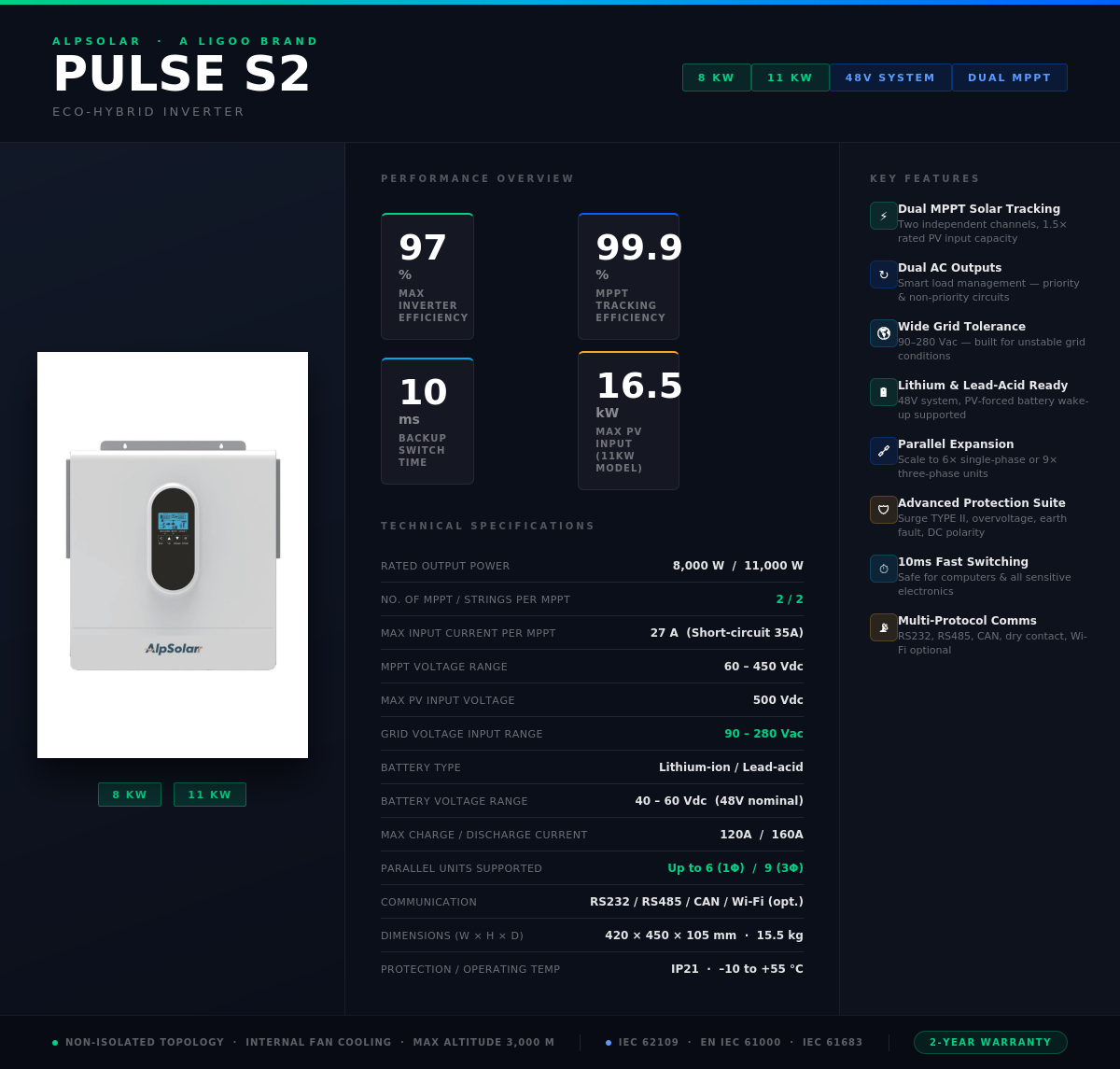
Here is the complete specification sheet for the Alpsolar Pulse S2 11kW.
| Category | Specification | Value |
|---|---|---|
| Output | Rated output power | 11,000W |
| Output | Rated output current | 48A |
| Output | Output frequency | 50 to 60Hz |
| Battery | Battery type | Lithium-ion and lead-acid |
| Battery | Battery voltage | 48V |
| Battery | Voltage range | 40V to 60V |
| Battery | Max charge / discharge current | 150A / 220A |
| Solar | Maximum PV input power | 2 x 8,250W |
| Solar | Maximum PV voltage | 500V |
| Solar | MPPT voltage range | 60V to 450V |
| Solar | MPPT trackers | 2 |
| Solar | Strings per MPPT | 2 |
| Solar | Max current per MPPT | 27A |
| Grid | Rated grid voltage | 220 / 230 / 240V, plus or minus 5% |
| Grid | Grid voltage range | 90V to 280V |
| Grid | Maximum grid input current | 60A |
| Efficiency | Maximum efficiency | 97% |
| Efficiency | MPPT efficiency | 99.9% |
| Communication | Ports | RS232, RS485, CAN, dry contact, parallel, optional WiFi |
How Efficiency Ratings Protect Your Returns
The Pulse S2 reaches 97% maximum efficiency. Its MPPT efficiency is 99.9%. These two numbers decide how much of your solar production reaches your loads.
Every inverter loses some energy as heat. A high-efficiency solar inverter loses less. Over years, that gap adds up to real money.
Here is a simple example. Assume a 12kW array produces about 60kWh of DC energy on a good day. A 97% efficient inverter delivers 58.2kWh. A 92% efficient inverter delivers only 55.2kWh.
The difference is 3kWh every day. That is about 1,095kWh a year. At the Band A rate of ₦209.50 per kWh, you lose roughly ₦229,000 annually with the weaker unit.
Heat also shortens electronics life. Mount your solar inverter in a shaded, ventilated space. Leave clear space around it, and never install it in a sealed cupboard.
What a Complete System Around This Solar Inverter Costs
The inverter is only one part of the system. Many buyers forget the rest. Here is an illustrative budget for a complete 12.4kW solar array with 16kWh of lithium storage.
| Component | Detail | Estimated Cost |
|---|---|---|
| Alpsolar Pulse S2 11kW solar inverter | 1 unit | ₦1,050,000 |
| Trina 620W solar panels | 20 panels at ₦133,000 | ₦2,660,000 |
| HiTHIUM 16kWh lithium battery | 1 unit | ₦2,650,000 |
| Mounting, cabling, protection, installation | Site dependent | ₦600,000 to ₦900,000 |
| Estimated total | ₦6,960,000 to ₦7,260,000 |
Component prices come from our shop listings at the time of writing. The installation line is an estimate, and your site may differ. Prices also move with the naira exchange rate.
If you prefer a pre-matched option, browse our complete solar packages. You can also view every hybrid inverter we stock.
Payback: How Fast Does This Solar Inverter System Pay Back?
Let me work through a realistic diesel example. Suppose your generator runs 6 hours a day. It burns about 2.5 litres per hour at this load. Diesel costs around ₦1,800 per litre.
That is 15 litres a day, or ₦27,000 daily. Over 30 days, you spend about ₦810,000 on fuel. That excludes servicing, oil, and repairs.
Now assume solar and battery cover 80% of that runtime. You save about ₦648,000 every month. Against a ₦7,110,000 system, payback lands near 11 months.
Your numbers may differ. If your generator runs only 2 hours a day, monthly fuel is about ₦270,000. An 80% saving is ₦216,000 monthly. Payback then stretches to about 33 months.
I always tell customers to measure their fuel spend first. Track it for two weeks. Then size the system against real data, not guesses.
Who Should Buy This Solar Inverter, and Who Should Skip It
This inverter is a strong fit for several buyers.
- Large homes and duplexes with several air conditioners
- Offices with servers, printers, and multiple workstations
- Hotels and guest houses with round-the-clock loads
- Clinics that need stable power for equipment
- Schools, campuses, and small factories
It is not the right tool for everyone. A 3-bedroom flat with light loads does not need 11kW. You would pay for capacity you never use.
For smaller homes, look at the Alpsolar 6kVA hybrid inverter at ₦870,000. You can also consider a ready-made 5kVA solar system. Both suit typical family homes better.
If you run three-phase machinery, tell us early. The Pulse S2 supports three-phase parallel configurations. Your setup needs proper engineering, so do not guess.
Installation, Safety, and Standards
A great solar inverter can still fail if it is poorly installed. Most premature failures I see trace back to bad earthing, loose terminals, or missing surge protection. These are all preventable.
Insist on the following checks.
- Earthing that meets the requirements of NEMSA
- DC and AC surge protection devices
- Breakers sized for the 60A maximum grid input
- Correct cable sizes for 220A battery discharge current
- Ventilated mounting away from direct sun and moisture
- Installation by COREN-registered engineers
Ask your supplier for safety and compliance documents. Power electronics for solar systems are typically assessed against standards such as IEC 62109. You can learn more about international standards at the International Electrotechnical Commission.
Get a written commissioning report after installation. It should list settings, test readings, and earthing results. Keep it with your warranty papers.
Financing Your Solar Inverter System
You do not need the full amount upfront. Several Nigerian banks offer solar loans. Access Bank Switch to Solar supports solar purchases with low equity contributions.
FCMB solar financing can cover a large share of system cost. Fidelity Bank Green Energy Finance supports larger installations. Terms change, so confirm current rates with each bank.
We also offer direct equipment financing. It gives you one contact from quote to installation. Many customers like that simplicity.
Warranty and After-Sales Support
The Alpsolar Pulse S2 carries a 2-year manufacturer warranty. Every purchase from us also includes practical support.
- Professional installation support
- System configuration
- Monitoring setup
- Technical consultation
Two years is shorter than the warranty on batteries and panels. So plan your maintenance. Clean panels regularly, check terminals twice a year, and update monitoring settings when you add capacity.
Get Your 11kW Solar Inverter Today
The Alpsolar Pulse S2 gives you serious capacity at a fair price. You get dual MPPT, wide grid tolerance, fast switching, and room to expand. For large homes and commercial sites, it is a smart foundation.
View the full listing here: Alpsolar 11kW 48V Hybrid Inverter. Browse our full shop for panels, batteries, and packages. Or contact us for a free consultation and a system sized around your real load.
Call or WhatsApp: 0814 596 4127. Visit us at Plot 4b Greenlite Estate, Ibeju Lekki, Lagos. For more guides, read our solar blog.
Frequently Asked Questions
How much does an 11kW solar inverter cost in Nigeria?
The Alpsolar Pulse S2 11kW solar inverter costs ₦1,050,000 at Mindseye Solar, reduced from ₦1,200,000. A complete system with panels, lithium battery, and installation costs around ₦7 million. Your site and component choices will shift that figure.
What can an 11kW solar inverter power?
An 11kW solar inverter can run several air conditioners, freezers, a borehole pump, computers, lighting, and office equipment together. Keep continuous load below 70% to 80% of rated output, roughly 7,700W to 8,800W, for best reliability.
How many solar panels does an 11kW solar inverter need?
The Pulse S2 accepts up to 16,500W of PV input. A practical array is 12kW to 15kW, which means about 20 to 24 panels of 620W. Your installer must verify string voltage against the 500V limit.
Which batteries work with the Alpsolar Pulse S2?
It works with 48V lithium-ion and lead-acid batteries within a 40V to 60V range. Compatible lithium brands include HiTHIUM, Deye, and Leoch. The inverter supports 150A maximum charging and 220A maximum discharging.
How fast does this solar inverter switch during a blackout?
The Pulse S2 has a 10ms transfer time. That is fast enough to keep computers and network equipment running through most grid outages. Sensitive medical or server equipment may still need dedicated UPS protection.
Can I connect more than one Alpsolar 11kW inverter?
Yes. You can connect up to 6 single-phase units in parallel, giving 66kW of combined output. Three-phase setups support up to 9 units. Parallel systems need matched hardware and professional commissioning.
Does a solar inverter work with unstable grid voltage?
Yes. The Pulse S2 accepts grid voltage from 90V to 280V. It also has surge, overvoltage, short-circuit, and earth fault protection. This makes it well suited to Nigeria’s fluctuating supply.
How long does a solar inverter system take to pay for itself?
For a business running a diesel generator six hours daily, payback can land near 11 months. With only two hours of daily generator use, expect about 33 months. Measure your real fuel spend first.