
Description
MEM 250L Solar Water Heater: Powerful, Reliable Hot Water for Every Season
If you are looking for a dependable solar water heater that can provide hot water while reducing dependence on conventional electric heating, the MEM 250L Pressurized Vacuum Tube Solar Water Heater is a practical solution for modern homes, hotels, offices, guest houses, hospitals, and other properties.
The MEM 250L combines evacuated vacuum tube technology, insulated water storage, and an integrated AC electric heating ring to deliver hot water across different weather conditions.
Instead of relying entirely on electricity or gas to heat water, the system captures thermal energy from sunlight and stores it for later use.
For homes and businesses in Nigeria, where sunlight is available for much of the year, installing a solar water heater can be an effective way to reduce the energy required for domestic hot-water production.
The MEM system is available in several capacities, including 100L, 150L, 200L, 250L, 300L, and 500L, allowing users to select a configuration appropriate for their household or commercial hot-water demand.
Why Choose the MEM 250L Solar Water Heater?
A good solar water heater should do more than simply heat water when the sun is shining. It should retain heat, provide sufficient storage, operate reliably, and offer a practical backup when solar energy is insufficient.
The MEM 250L is designed around those requirements.
Its evacuated vacuum tubes absorb solar radiation and transfer heat to the water system. The insulated storage tank helps reduce heat loss, allowing heated water to remain useful for longer periods.
An integrated AC electric ring provides additional heating when sunlight is insufficient, particularly during prolonged cloudy or rainy conditions.
This combination makes the MEM 250L suitable for users who want renewable solar heating without completely giving up the convenience of electrical backup.
Advanced Vacuum Tube Technology for Better Heat Collection
The heart of this solar water heater is its evacuated tube collector technology.
Evacuated tubes are designed with a vacuum layer that helps reduce heat loss from the heated surface to the surrounding environment. This allows the collector to capture solar energy efficiently while limiting the amount of heat that escapes.
The tubes absorb solar radiation and convert it into thermal energy. That heat is then transferred to the water system and stored in the insulated tank.
For a property that uses significant quantities of hot water, this approach can reduce the amount of electricity that would otherwise be required by conventional electric water heaters.
How the Vacuum Tubes Work
Each evacuated tube functions as a highly insulated solar thermal collector.
Sunlight enters the tube and is absorbed by the collector surface. The resulting thermal energy heats the water circulating through the system.
Because the tube incorporates a vacuum layer, heat transfer to the surrounding air is reduced.
The result is a highly effective thermal collection system that can continue producing useful heat under a wide range of sunlight conditions.
This is one of the major reasons evacuated-tube technology remains popular for residential and commercial solar thermal applications.
250L Capacity for Homes and Commercial Applications
The 250L storage capacity makes this solar water heater a useful middle-ground option for properties requiring more hot water than a small domestic system can provide.
Depending on consumption patterns, a 250L tank can support multiple users and applications.
It can be considered for:
- Large family homes
- Duplexes
- Guest houses
- Small hotels
- Staff accommodation
- Restaurants
- Offices
- Schools
- Clinics
- Worship centres
- Salons and spas
- Commercial residential properties
Actual hot-water demand varies considerably depending on the number of occupants, bathing habits, water temperature requirements, and whether hot water is also required for kitchens, laundry, cleaning, or other applications.
For larger facilities, the MEM range also provides 300L and 500L alternatives.
Powerful All-Weather Backup With AC Electric Ring
One of the most useful features of the MEM system is the integrated AC electric ring.
Solar thermal systems naturally depend on available solar radiation. During periods of heavy cloud cover, rainfall, or unusually low sunlight, thermal energy collection can be reduced.
The electric heating element provides a backup source of heat.
This means users do not necessarily have to wait for strong sunlight before obtaining hot water.
The AC heating element can supplement the solar thermal system when necessary, making the solar water heater considerably more practical for everyday use.
Rather than installing a completely separate electric water heater, the integrated backup provides another heating option within the same system.
Efficient Heat Retention
Collecting heat is only part of the job.
A good water-heating system must also retain that heat.
The MEM 250L incorporates an insulated storage tank designed to reduce heat loss after the water has been heated.
This is particularly important because hot water may not always be consumed immediately after the solar collector has heated it.
Effective insulation helps maintain useful water temperatures for longer periods and reduces the need to repeatedly reheat the stored water.
For households using hot water primarily in the morning and evening, heat retention can be especially valuable.
Durable Construction for Long-Term Use
Solar water-heating equipment is exposed to outdoor environmental conditions, including sunlight, rain, humidity, dust, and temperature variations.
The MEM system uses corrosion-resistant materials intended to support long-term operation with appropriate installation and maintenance.
However, durability does not mean maintenance should be ignored.
Regular inspection of the tubes, connections, valves, tank, mounting structure, and plumbing helps identify potential problems before they become expensive repairs.
A professionally installed solar water heater should also be positioned securely and installed according to the manufacturer’s technical requirements.
Strong Standing Rack for Proper Solar Positioning
The standing rack supports the solar collector assembly and positions the tubes to receive useful solar radiation.
Correct orientation and inclination are important because the performance of a solar thermal collector depends partly on how effectively it receives sunlight.
During installation, the installer should consider the property’s location, roof structure, available space, shading, orientation, and local solar conditions.
Avoid placing the collector where nearby buildings, walls, trees, tanks, or other structures will cast significant shadows across the tubes.
A technically excellent solar water heater can still underperform if its collector is poorly positioned.
Built-In Water Filtration
The MEM system also incorporates a water filter designed to help maintain cleaner water flow.
Water quality can vary significantly depending on the source.
Borehole water, municipal water, storage tanks, and other sources can contain suspended particles or sediments that may affect plumbing components over time.
Using appropriate filtration and maintaining the filter according to installation requirements can help protect the water system.
Where water quality is a known concern, additional filtration or water-treatment equipment may be appropriate.
Solar Water Heater vs Conventional Electric Water Heater
Traditional electric water heaters use electrical energy directly to generate heat.
A solar thermal system approaches the problem differently.
Instead of using electricity as its primary energy source, the collector captures thermal energy from the sun.
This can reduce the amount of electrical energy needed to heat water.
The difference can become particularly significant in properties where hot water is required frequently.
For example, a hotel with numerous guests may consume substantial energy heating water throughout the day. Using solar thermal technology can offset part of this demand.
The integrated AC heating ring provides additional flexibility when solar energy is insufficient.
Why Solar Water Heating Makes Sense in Nigeria
Nigeria receives substantial solar radiation across much of the country, making solar technologies particularly relevant for domestic and commercial energy applications.
A solar water heater takes advantage of this naturally available resource for thermal energy rather than converting sunlight into electricity first.
That distinction is important.
Solar photovoltaic panels generate electricity, while solar thermal collectors directly capture heat.
If the primary requirement is hot water, a solar thermal system can therefore be a highly direct approach.
For additional background on solar energy resources and technology, the International Energy Agency’s solar energy resources provides useful information on the wider role of solar energy.
The U.S. Department of Energy’s Energy Saver resources also provides useful technical information about water heating and energy efficiency.
Lower Dependence on Grid Electricity
Electricity costs are an important consideration when choosing a water-heating system.
Heating water can require substantial energy because water has a relatively high heat capacity.
When an electric heater is used repeatedly, the energy consumption can accumulate over time.
A solar water heater reduces the need to use electricity as the primary heating source whenever sufficient solar energy is available.
The MEM 250L therefore provides an opportunity to use sunlight for the majority of the heating process while retaining electrical backup for periods when additional heating is required.
For businesses, this can be particularly attractive because reducing recurring energy consumption can improve operating efficiency.
Suitable for Homes, Hotels and Commercial Properties
The MEM 250L is not restricted to residential applications.
It can also be considered for commercial installations where hot water is an important part of daily operations.
Residential Applications
For residential properties, the system can provide hot water for:
- Showers
- Bathrooms
- Kitchens
- Cleaning
- Laundry
- General domestic use
The actual number of users supported comfortably will depend on their consumption pattern and the desired hot-water temperature.
Hotels and Guest Houses
Hotels and guest houses are strong candidates for solar thermal technology because hot water can represent a continuous operational requirement.
Guests expect reliable hot water regardless of the weather.
The combination of solar heating and AC backup makes the MEM system particularly useful for such applications.
For larger facilities, multiple units can potentially be considered as part of a properly engineered hot-water system.
Offices and Institutions
Schools, offices, hospitals, staff quarters, and worship centres may also benefit where hot-water requirements justify the investment.
The correct capacity should be selected based on actual demand rather than simply choosing the largest available tank.
Available Capacity Options
Although this product is the MEM 250L model, the wider product range provides several storage capacities.
Available options include:
| Capacity | Typical Application |
|---|---|
| 100L | Small household or low hot-water demand |
| 150L | Small families and modest applications |
| 200L | Medium household requirements |
| 250L | Larger households and selected commercial applications |
| 300L | Higher domestic or commercial demand |
| 500L | High-demand residential and commercial applications |
The correct capacity depends on the number of users, peak consumption, water temperature requirements, available solar exposure, and backup-heating strategy.
Key Components of the MEM 250L System
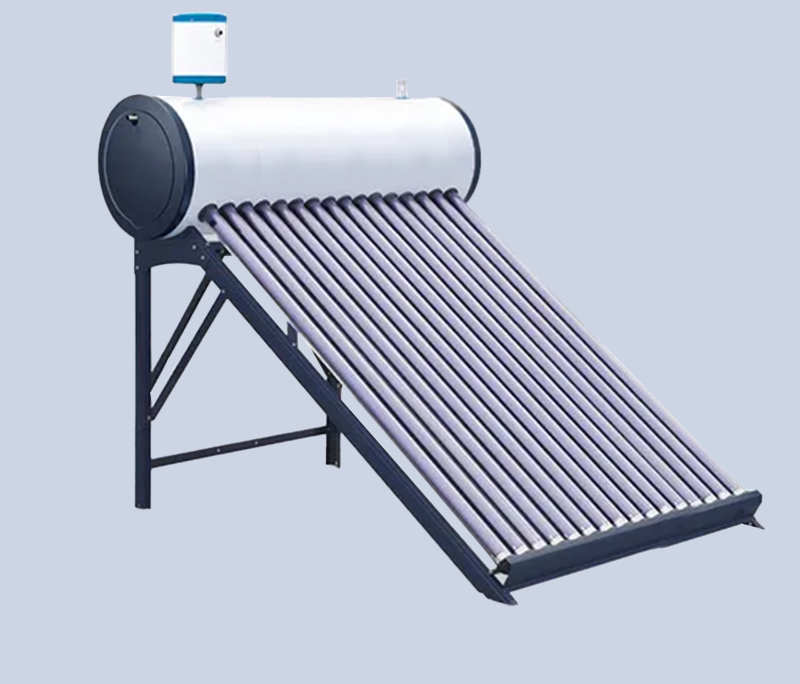
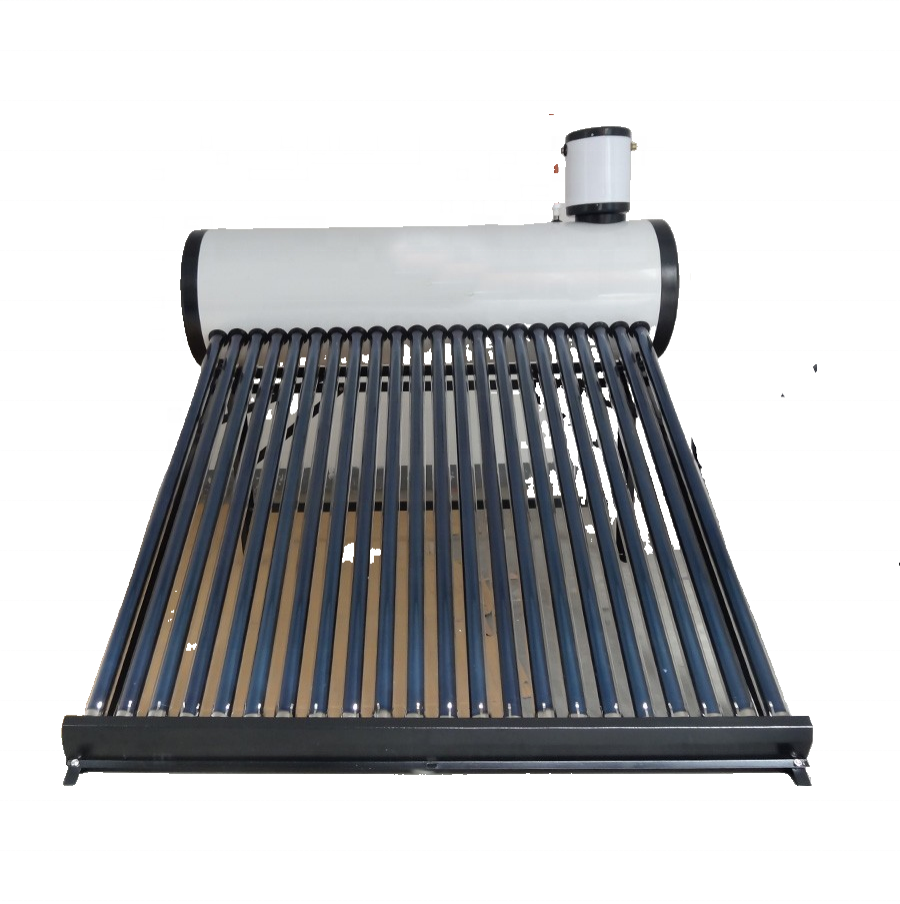
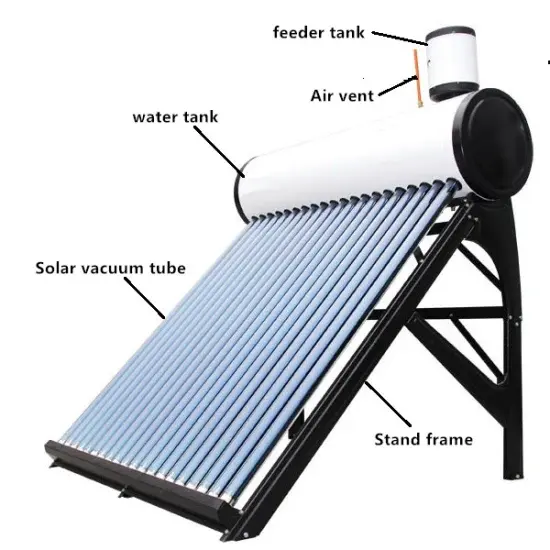
The MEM 250L solar water heater combines several components into one integrated thermal system.
1. High-Efficiency Vacuum Tubes
The evacuated tubes are responsible for collecting solar thermal energy.
Their design helps reduce heat loss while allowing solar radiation to be converted into useful heat.
2. Insulated Storage Tank
The storage tank holds heated water and uses insulation to reduce thermal losses.
This allows collected heat to remain available after the peak solar collection period.
3. Standing Rack
The rack provides structural support and positions the tubes appropriately.
It must be installed securely and on a suitable surface capable of supporting the complete system.
4. Water Filter
The filter helps keep the water flow cleaner and can help reduce the entry of unwanted particles into the system.
Maintenance requirements will depend on local water quality.
5. AC Electric Ring
The electric ring provides supplementary heating during periods when solar energy is insufficient.
This backup feature improves the practicality of the system for everyday use.
Installation Matters More Than Many Buyers Realize
Buying a high-quality solar water heater is only part of achieving good performance.
Installation has a major influence on the final result.
The collector should have adequate exposure to sunlight.
The mounting structure must be stable.
Pipework should be appropriately installed and insulated where required.
Water connections should be checked carefully for leaks.
The installer should also assess the roof or ground-mounted location before installation.
Poor installation can reduce system efficiency, create safety issues, or shorten equipment life.
For commercial projects, installation should be designed around the facility’s actual hot-water demand rather than simply connecting equipment without a load assessment.
Maintenance Requirements
The MEM system is designed for relatively low maintenance, but no mechanical or thermal system should be installed and forgotten.
Periodic maintenance should include:
- Inspecting vacuum tubes
- Checking plumbing connections
- Inspecting valves and fittings
- Cleaning components where required
- Checking the water filter
- Inspecting the mounting rack
- Checking for leaks
- Checking electrical connections to the AC heating element
- Monitoring hot-water performance
The frequency of inspection depends on water quality, environmental conditions, usage, and installation quality.
How to Get the Best Performance From Your Solar Water Heater
Several practical steps can improve the performance of a solar water heater.
First, make sure the collector receives sufficient sunlight.
Second, keep the solar tubes reasonably clean.
Third, avoid unnecessary shading.
Fourth, make sure the storage tank and associated pipework are properly insulated where applicable.
Fifth, service the system when performance changes noticeably.
Finally, choose the correct capacity for the property’s actual requirements.
An undersized system may struggle to meet peak demand, while an unnecessarily oversized system may increase the initial investment without delivering proportional benefits.
Is the MEM 250L Right for You?
The MEM 250L is worth considering if your priority is reliable hot water combined with reduced dependence on conventional electric heating.
It is especially suitable for buyers who want:
- Solar-powered water heating
- Large hot-water storage
- Reduced electricity consumption
- Electric backup heating
- Vacuum tube technology
- Low-maintenance operation
- Residential or commercial flexibility
- A system designed for year-round use
If your property has a high demand for hot water, the 300L or 500L models may be more appropriate.
If the demand is lower, the 100L, 150L, or 200L options may provide a better fit.
Combine Solar Water Heating With a Complete Energy Strategy
A solar water heater can form part of a broader energy-efficiency strategy.
For example, a property may use solar photovoltaic panels to generate electricity while using solar thermal equipment for hot water.
This separates two energy requirements.
Photovoltaic panels generate electrical power for appliances, lighting, pumps, and electronics.
The solar thermal system directly produces hot water.
For customers considering a complete solar power installation, explore our solar inverters and energy systems at Mindseye Solar.
You can also learn more about solar technology through our solar energy resources and articles, where we cover practical solar-energy topics relevant to Nigerian homes and businesses.
Smart Investment for Long-Term Hot-Water Demand
The value of a solar water heater should not be measured only by its purchase price.
The more important question is how much useful hot water it can provide over its operating life and how much conventional energy it can displace.
For properties that consume hot water regularly, the energy savings can accumulate over time.
The system also reduces dependence on grid electricity for one of the most energy-intensive domestic heating applications.
The integrated electric ring means users still have access to backup heating when solar conditions are unfavorable.
That combination provides a practical balance between renewable energy and convenience.
Frequently Asked Questions
What is a solar water heater?
A solar water heater uses energy from sunlight to heat water. Solar thermal collectors capture heat from solar radiation and transfer that thermal energy to water stored in a tank.
How does the MEM 250L solar water heater work?
The MEM 250L uses evacuated vacuum tubes to collect solar thermal energy. The collected heat is transferred to the water system, while the insulated tank stores heated water. An integrated AC electric ring provides backup heating when additional heat is required.
Does the MEM 250L work when it rains?
Yes, but solar thermal output can be reduced during heavy cloud cover or rainfall because less solar radiation reaches the collectors. The integrated AC electric ring provides backup heating during periods of insufficient sunlight.
How much water can the MEM 250L store?
The nominal storage capacity is 250 litres.
Can the MEM system be used in a hotel?
Yes. Solar water heating can be particularly useful in hotels and guest houses because these facilities can have substantial daily hot-water requirements. Larger properties may require multiple units or a higher-capacity configuration following a proper demand assessment.
Does a solar water heater require electricity?
The solar heating function does not require conventional electricity as its primary energy source. However, the MEM system includes an AC electric heating ring that can be used as supplementary heating.
How long does the hot water remain warm?
Heat retention depends on factors such as tank insulation, ambient temperature, water temperature, usage, and installation conditions. The insulated storage tank is designed to minimize unnecessary heat loss.
Can I use the system in a residential building?
Yes. The MEM 250L can be considered for homes, duplexes, guest houses, and other residential properties with sufficient space and appropriate installation conditions.
What maintenance does the system require?
Routine inspection should include the vacuum tubes, storage tank, plumbing connections, filter, mounting rack, electrical connections, and general system condition.
Is the MEM 250L environmentally friendly?
Yes. Solar thermal heating uses renewable solar energy and can reduce the amount of conventional electricity required for hot-water production.
Order the MEM 250L Solar Water Heater From Mindseye Solar
If you are ready to reduce your dependence on conventional electric water heating, the MEM 250L offers a practical combination of solar thermal collection, insulated storage, and electric backup heating.
The system is particularly attractive for Nigerian homes and businesses that need dependable hot water while looking for ways to control recurring energy costs.
Whether you are building a new home, upgrading an existing property, developing a guest house, or planning a commercial hot-water installation, selecting the correct capacity and installing it properly are essential to achieving the expected performance.
View the MEM 250L Pressurized Vacuum Tube Solar Water Heater here:
https://mindseyesolar.com/shop/mem-250l-pressurized-vacuum-tube-solar-water-heater/
For other solar products, visit the Mindseye Solar Shop and explore our range of solar inverters, batteries, panels, generators, and energy solutions.
A well-designed solar water heater is more than a way to get hot water. It is an opportunity to use an abundant renewable resource, reduce unnecessary electricity consumption, and build a more efficient energy system for your property.
Final Verdict
The MEM 250L stands out as a practical solar water heater for users who want substantial hot-water storage, efficient evacuated-tube solar collection, and dependable electrical backup.
Its 250-litre capacity provides a useful balance between storage and household or commercial demand, while the available 100L, 150L, 200L, 300L, and 500L variants make it easier to scale the system to different requirements.
With proper installation, appropriate positioning, routine inspection, and sensible water usage, the MEM system can become a valuable part of a property’s long-term hot-water strategy.
For homes and businesses seeking a cleaner and potentially more economical way to produce hot water, the MEM 250L is a powerful, practical, and efficient solar water heater solution.