
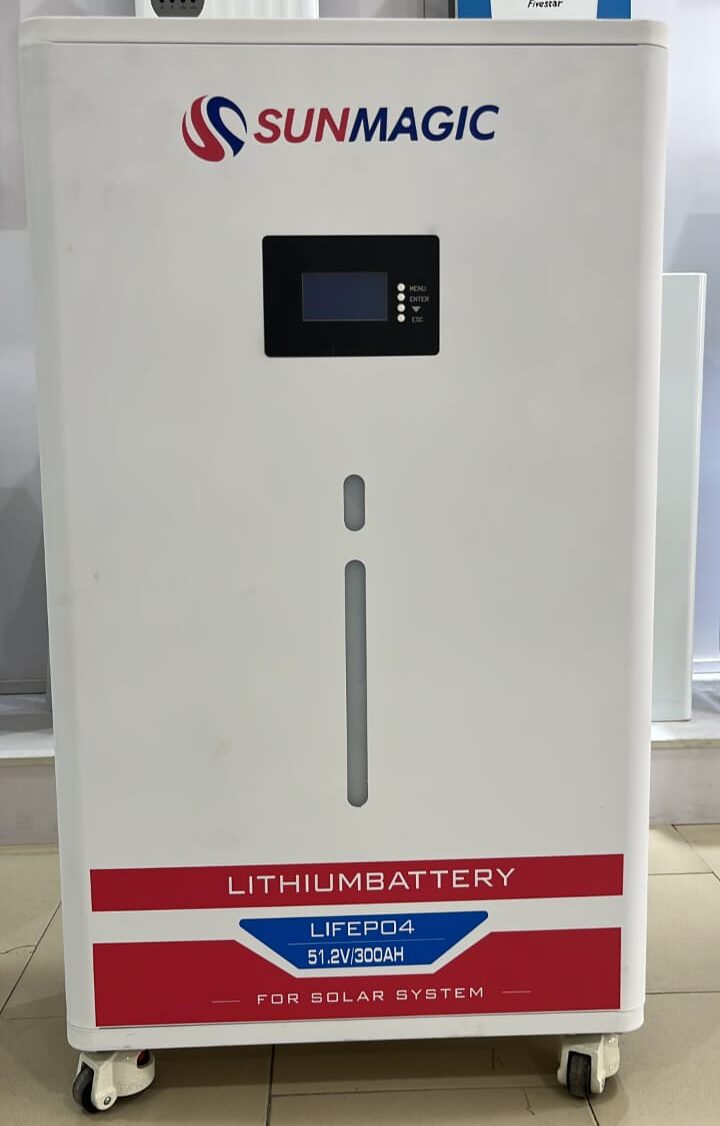
Description
15kWh Lithium Battery: Powerful 7-Year Energy Storage for Homes and Businesses
If you need dependable energy storage for a home, office, shop, hotel, clinic, or other commercial property, choosing the right battery is just as important as choosing the right inverter and solar panels.
This 15kwh lithium battery is designed for customers who need substantial energy storage without immediately moving into a large multi-battery installation.
With a rated voltage of 51.2V, usable capacity of 15,360Wh, maximum continuous discharge current of 150A, maximum output power of 10.24kW, and a stated cycle life of more than 8,000 cycles, this battery is built for serious solar energy storage applications.
It also comes with a 7-year warranty, giving buyers an additional layer of confidence when planning a long-term solar installation.
For Nigerian homes and businesses dealing with unreliable grid supply, generator costs and the need for uninterrupted power, a 15kwh lithium battery can form the central storage component of a properly designed solar system.
View the Sun Magic 15kWh Lithium Battery product page
Why Choose a 15kWh Lithium Battery?
The biggest advantage of a 15kwh lithium battery is the amount of usable energy available from a single battery unit.
The specification lists a usable capacity of 15,360Wh, equivalent to 15.36kWh.
That gives you considerably more storage than smaller 5kWh or 10kWh batteries and can reduce the number of separate battery units required for a medium or large solar installation.
A properly sized 15kwh lithium battery can be used for applications where overnight energy storage is important.
Depending on the actual load, it can support lighting, televisions, refrigeration, networking equipment, computers, fans, pumps and other household or commercial equipment through periods when solar generation is unavailable.
The actual runtime will always depend on the combined wattage of the equipment being powered.
For example, a 1kW average load would theoretically consume 1kWh per hour. A 15.36kWh battery therefore has considerably more energy available than a 5kWh battery, although inverter losses, battery operating limits and other system factors must be considered.
51.2V Architecture for Modern Solar Systems
The battery operates at a rated voltage of 51.2V.
This is an important specification because battery voltage must be compatible with the inverter and the rest of the DC system.
Many modern residential and commercial solar systems use approximately 48V nominal battery architecture. A 51.2V battery is commonly used within this class of high-voltage DC battery-bank applications.
Before purchasing a 15kwh lithium battery, always confirm that your inverter supports the battery voltage range.
This particular battery has a specified voltage range of 43.2V to 59.2V.
The inverter should also be compatible with the battery’s communication requirements where communication between the inverter and battery management system is supported.
Do not select an inverter based only on its advertised kVA rating. Battery voltage, maximum charging current, maximum discharge current and communication compatibility all matter.
15.36kWh Usable Energy Capacity
One of the strongest specifications of this 15kwh lithium battery is its stated usable energy capacity of 15,360Wh.
In simpler terms, that is 15.36kWh.
The relationship is straightforward:
51.2V × 300Ah = 15,360Wh
This explains why the battery is commonly described as a 15kWh-class battery.
The large capacity gives system designers more flexibility when calculating overnight backup requirements.
For example, a household with an average evening load of 2kW could theoretically consume around 8kWh over four hours. A battery in the 15kWh class provides substantially more storage headroom than a smaller battery, subject to inverter efficiency, actual battery limits and other system conditions.
For a commercial installation, the same capacity can be used differently.
A business may prioritize computers, networking equipment, security systems, lighting and refrigeration rather than attempting to power every appliance simultaneously.
That is why proper load assessment is essential before installing a 15kwh lithium battery.
More Than 95% Depth of Discharge
The specification states a depth of discharge of greater than 95%.
Depth of discharge, commonly abbreviated as DoD, describes how much of a battery’s stored energy can be used during operation.
A higher usable DoD can allow more of the battery’s rated capacity to contribute to the customer’s actual energy needs.
This is one reason buyers should look beyond the headline capacity when comparing batteries.
Two batteries can both be marketed as 15kWh products while providing different usable capacities depending on their operating limits and manufacturer specifications.
With a 15kwh lithium battery, the stated DoD specification is particularly relevant because it indicates that the system is designed to make a large portion of its stored energy available for use.
Actual usable energy can still vary depending on operating conditions, battery temperature, inverter efficiency, configuration and battery management settings.
150A Maximum Continuous Discharge
The battery has a maximum continuous discharge current of 150A.
This is an important specification when matching the battery to an inverter.
At a nominal 51.2V, 150A corresponds to approximately 7.68kW:
51.2V × 150A = 7,680W
That figure is consistent with the stated recommended output power of 7,680W.
The manufacturer also lists a maximum output power of 10,240W.
The difference between recommended output power and maximum output power is worth understanding.
A system designer should not automatically assume that the battery should continuously operate at its maximum advertised output.
For long-term system design, the recommended operating specification is normally more useful when matching the battery to an inverter and expected load profile.
This makes the 15kwh lithium battery particularly interesting for systems built around approximately 6kW to 8kW continuous loads, depending on the inverter and installation design.
200A Maximum Continuous Charging Current
The specification also lists a maximum continuous charging current of 200A.
This gives the battery substantial charging capability.
However, maximum charging current does not mean that every solar installation should charge the battery at 200A.
The appropriate charging current depends on the battery manufacturer’s recommended settings, inverter specifications, solar array size, battery temperature, system design and other factors.
An installer should configure the charging system according to the manufacturer’s documentation rather than simply selecting the highest available current.
For a 15kwh lithium battery, correct charging configuration is particularly important because the battery represents a significant amount of stored energy.
Official lithium battery installation guidance from Victron Energy, for example, emphasizes correct charging profiles, BMS communication, appropriate cabling and properly rated protection.
Victron Energy lithium battery installation guidance
More Than 8,000 Charging Cycles
The product specification states a cycle life of more than 8,000 cycles.
Cycle life is one of the most important specifications to examine when purchasing a 15kwh lithium battery.
A battery cycle broadly represents the use and replenishment of stored energy, although manufacturers can define testing conditions differently.
The actual service life of a battery depends on factors such as operating temperature, charge and discharge rates, depth of discharge, storage conditions and battery management.
Therefore, the advertised cycle figure should be understood as a manufacturer’s specification rather than a guaranteed number of years under every operating condition.
Nevertheless, a stated cycle life exceeding 8,000 cycles represents a substantial design target for a battery intended for frequent energy storage applications.
7-Year Warranty
The product comes with a 7-year warranty.
Warranty duration is important when evaluating a major solar investment because a battery is often one of the most expensive components in an energy storage system.
A warranty should not be judged by the number of years alone.
Buyers should also confirm the warranty terms, exclusions, installation requirements, operating conditions and the process for making a claim.
For anyone considering a 15kwh lithium battery, it is sensible to retain the invoice, serial number, product documentation and installation records.
These documents can become important if technical support or warranty service is required.
Where Can You Use a 15kWh Battery?
A 15kwh lithium battery can be used in several residential and commercial applications.
Residential Solar Systems
Large homes with several appliances can benefit from a battery of this capacity.
Typical loads may include:
- Refrigerators
- Freezers
- Fans
- Lighting
- Televisions
- Internet equipment
- Computers
- Security systems
- Washing machines
- Selected kitchen appliances
The important point is that the battery should not be sized simply according to the number of rooms in a house.
The correct approach is to calculate the actual energy consumption and identify which loads need backup.
Offices and Small Businesses
A 15kwh lithium battery can also support office environments.
For example, an office may need backup for computers, networking equipment, printers, lighting, security equipment and selected air-conditioning loads.
The objective does not always have to be powering every appliance.
A properly designed system can prioritize essential loads while leaving high-consumption equipment on the grid or generator when necessary.
Shops and Commercial Premises
Retail stores, pharmacies, salons, restaurants and other businesses can use battery storage to reduce dependence on generators and improve power continuity.
A 15kwh lithium battery can provide stored energy during periods of low solar production and grid outages.
The exact runtime depends on the load.
A 500W average load consumes approximately 0.5kWh per hour.
A 2kW average load consumes approximately 2kWh per hour.
This simple calculation demonstrates why load management is critical.
How Long Will the Battery Last?
Customers frequently ask how long a 15kwh lithium battery will run their appliances.
There is no single answer because runtime depends on load.
A useful calculation is:
Approximate runtime = usable battery energy ÷ average load
For example, a 15.36kWh battery supplying an average 1.5kW load would theoretically provide approximately:
15.36 ÷ 1.5 = 10.24 hours
However, this should not be interpreted as a guaranteed 10.24-hour runtime.
Real installations experience inverter losses and other electrical losses.
The actual runtime may therefore be lower.
If the average load rises to 3kW, theoretical runtime becomes approximately:
15.36 ÷ 3 = 5.12 hours
This demonstrates why the best way to size a 15kwh lithium battery is to start with your actual load profile rather than simply choosing a battery based on its capacity.
Pairing the Battery With a Solar Inverter
The inverter is responsible for converting energy between the battery’s DC supply and the AC power used by most household and commercial appliances.
A 15kwh lithium battery should therefore be matched with an inverter capable of operating correctly with its voltage and current specifications.
Pay particular attention to:
- Battery voltage compatibility.
- Maximum charging current.
- Maximum battery discharge current.
- Battery communication protocol.
- CAN or RS485 compatibility where applicable.
- Inverter output rating.
- Solar PV input capacity.
- Required protection equipment.
Communication between the battery BMS and compatible inverter can provide important operating information and protection functions.
This is why battery compatibility should be checked before installation rather than assumed from the battery’s nominal voltage alone.
Installing the Battery Correctly
A 15kwh lithium battery weighs approximately 128.85kg net according to the supplied specification.
The boxed gross weight is approximately 149kg.
This is a substantial piece of electrical equipment and should be installed by suitably qualified personnel.
The supplied package includes:
- One LT300 51.2V lithium-ion battery
- One communication cable
- Two battery cables, red and black
- Four mounting screws
- One wall mounting bracket
- One manual
The supplied wall mounting bracket is useful for installations where the specified mounting arrangement is appropriate.
The installation surface must be strong enough to support the battery.
The battery should also be protected from unnecessary exposure to water, excessive heat, direct sunlight and physical impact.
Professional installation is particularly important for a 15kwh lithium battery because high-capacity batteries can deliver significant electrical current.
International standards also address safety requirements for stationary lithium-ion batteries.
IEC 62485-5 covers safety considerations for stationary lithium-ion battery installations, including protection against electrical hazards, short circuits and other installation risks.
IEC 62485-5 stationary lithium-ion battery safety standard
IEC 62619 also specifies safety requirements and tests for secondary lithium cells and batteries used in industrial applications, including stationary applications.
IEC 62619 lithium battery safety requirements
Battery Protection and BMS
The Battery Management System, commonly called the BMS, is an important part of modern lithium battery technology.
It monitors and manages battery operating conditions.
The BMS can provide protection against conditions such as excessive current, overcharging, excessive discharge and temperature-related problems, depending on the design of the particular battery.
The BMS should communicate correctly with the inverter when a closed-loop communication configuration is supported.
This makes the communication cable included with the 15kwh lithium battery an important component rather than an accessory that should simply be ignored.
During commissioning, the installer should confirm that the battery and inverter communicate correctly and that the configured voltage and current limits are appropriate.
The U.S. Department of Energy explains that rechargeable batteries store electrical energy through chemical processes and release it through an external circuit.
U.S. Department of Energy battery fundamentals
Why Battery Sizing Matters
Buying the largest battery available is not always the best approach.
Likewise, choosing a battery that is too small can lead to frequent deep cycling and insufficient backup.
When sizing a 15kwh lithium battery, start by listing every appliance that you expect the battery system to support.
Record the wattage of each appliance.
Then estimate how many hours each appliance operates during the backup period.
For example:
| Load | Approx. Power | Daily Runtime | Energy |
|---|---|---|---|
| Refrigerator | 150W average | 10 hours | 1.5kWh |
| Lighting | 300W | 6 hours | 1.8kWh |
| Fans | 300W | 8 hours | 2.4kWh |
| TV | 150W | 5 hours | 0.75kWh |
| Internet/networking | 50W | 10 hours | 0.5kWh |
The figures above are examples only.
Actual appliance consumption varies significantly.
Once the daily energy requirement has been calculated, the installer can determine whether a 15kwh lithium battery provides the required backup period.
For more guidance on our products, see our internal resource:
10kVA Complete Solar System Price: 7 Powerful Benefits for Reliable Nigerian
16kWh Lithium Battery in Nigeria: HiTHIUM HeroEE 16 for ₦2,650,000
Can You Add More Batteries Later?
Yes, the specification states that 1 to 5 units can be connected in parallel.
This provides an important scalability advantage.
A customer may begin with one 15kwh lithium battery and later expand the storage capacity if the system design and manufacturer’s installation requirements permit it.
Five units would represent a theoretical nominal capacity of approximately:
15.36kWh × 5 = 76.8kWh
That is a substantial energy storage bank suitable for much larger residential, commercial or institutional applications.
However, parallel expansion should not be treated as simply connecting additional batteries together.
The batteries, cables, protection devices, inverter configuration and communication system must all be designed for the expanded bank.
The manufacturer should also be consulted regarding approved parallel configuration.
Battery Cables and Electrical Protection
The supplied battery cables are included in the package, but the final installation may require additional cables or protection equipment depending on the system design.
Cable sizing should be based on expected current, cable length, installation method and applicable electrical requirements.
Protection should also be properly rated.
For high-current lithium battery installations, appropriate fusing and disconnect equipment are important.
Victron’s published installation guidance similarly emphasizes correctly sized battery cables and appropriately rated fuses because batteries can deliver very large currents.
This is another reason a 15kwh lithium battery should be installed by an experienced solar professional rather than connected using improvised wiring.
Maintenance and Monitoring
Lithium batteries generally require less routine maintenance than traditional lead-acid battery banks, but that does not mean they should be ignored after installation.
A 15kwh lithium battery should be monitored as part of the complete solar system.
Check for unusual BMS warnings.
Check that the inverter is communicating properly.
Inspect visible cable connections during scheduled maintenance.
Keep the battery and surrounding area clean and dry.
Avoid placing unnecessary objects around the battery.
The installer should also review system settings whenever the inverter firmware, battery firmware or system architecture changes.
Do not change battery charging parameters simply because a generic setting is available in an inverter menu.
Use the manufacturer’s documentation for the specific battery.
Is a 15kWh Battery Suitable for Your Home?
A 15kwh lithium battery can be a strong option for a home that needs more than basic backup capacity.
It may be particularly relevant to larger homes with multiple refrigeration loads, fans, lighting, entertainment equipment, security systems and other essential appliances.
However, air conditioners, electric cookers, water heaters, pressing irons and other high-power appliances can quickly increase energy consumption.
The battery’s 10.24kW maximum output specification should therefore not be interpreted as an instruction to run every high-power appliance simultaneously.
Instead, the solar system should be designed around the customer’s actual energy requirements.
A professional energy audit can help determine which appliances should be included in the essential-load circuit.
Is a 15kWh Battery Suitable for Business?
For businesses, a 15kwh lithium battery can provide a practical storage layer between solar generation and electricity consumption.
A small office might prioritize computers, networking equipment, lights, security equipment and selected cooling loads.
A shop may prioritize refrigerators, lighting, POS terminals and security systems.
A pharmacy may prioritize refrigeration and essential electrical equipment.
A hotel room block may require a completely different load profile.
This is why the same battery can be appropriate for one business and unsuitable for another.
The battery capacity is only one part of the system design.
What Comes With the Battery?
The package supplied with this 15kwh lithium battery includes the main items needed for the battery installation.
Package Contents
1 x LT300 51.2V Lithium-Ion Battery
This is the main 15.36kWh battery unit.
1 x Communication Cable
The communication cable is used where the battery and compatible inverter require a communication connection.
2 x Battery Cables
One red and one black cable are included.
4 x Mounting Screws
These are supplied for the specified mounting arrangement.
1 x Wall Mounting Bracket
The bracket provides the specified wall mounting option.
1 x Manual Book
The manual contains the manufacturer’s operating and installation information and should be retained.
Product Dimensions and Weight
The battery itself measures approximately:
970mm × 600mm × 250mm
The packaged dimensions are approximately:
1070mm × 620mm × 430mm
Net weight is approximately:
128.85kg
Gross packaged weight is approximately:
149kg
These measurements should be considered during delivery and installation planning.
Before ordering a 15kwh lithium battery, make sure there is sufficient space for the battery, mounting arrangement, cabling and required service access.
The installation location should also be selected with safety and environmental conditions in mind.
Why Buy From Mindseye Solar?
Choosing a battery is only part of a successful solar installation.
The quality of system design, inverter configuration, installation workmanship and after-sales support can have a major impact on the customer’s experience.
At Mindseye Solar, we focus on helping customers match energy storage with their actual requirements rather than simply selling a battery based on its advertised capacity.
If you are considering a 15kwh lithium battery, we can help you determine the appropriate inverter, solar panel capacity, protection equipment and expected backup requirements for your installation.
We also work with customers who need larger storage systems and multiple battery configurations.
Explore the Sun Magic 15kWh battery at Mindseye Solar
Frequently Asked Questions
What is a 15kwh lithium battery?
A 15kwh lithium battery is a rechargeable lithium-based energy storage system with approximately 15kWh of energy capacity. The model described here has a stated usable capacity of 15.36kWh and a rated voltage of 51.2V.
How much energy does the battery store?
This 15kwh lithium battery has a specified usable capacity of 15,360Wh, equivalent to 15.36kWh.
What is the voltage of the battery?
The rated voltage is 51.2V, with a specified operating voltage range of 43.2V to 59.2V.
What is the maximum discharge current?
The maximum continuous discharge current is 150A.
What is the recommended output power?
The specified recommended output power is 7,680W, while the listed maximum output power is 10,240W.
Can I connect multiple batteries?
Yes. The supplied specification states that between one and five units can be connected in parallel, subject to the manufacturer’s requirements and compatible system design.
How many cycles does the battery have?
The stated cycle life is more than 8,000 cycles. Actual service life depends on operating conditions, charging practices, temperature and usage.
Does the battery have a warranty?
Yes. The product specification states a 7-year warranty.
Can it run a house overnight?
A 15kwh lithium battery can provide substantial overnight storage, but the actual runtime depends on the average power consumption of the appliances connected to it.
Can I use it with a hybrid inverter?
It can be used with a compatible hybrid inverter, but voltage, current limits and battery communication compatibility should be confirmed before installation.
Is professional installation necessary?
Yes. A high-capacity battery should be installed and commissioned by appropriately qualified personnel using the manufacturer’s instructions and suitable electrical protection.
Final Verdict on the 15kWh Lithium Battery
For customers looking for substantial energy storage in a single battery unit, this 15kwh lithium battery offers a combination of useful capacity, high current capability, scalable parallel configuration and a 7-year warranty.
Its 15.36kWh usable capacity, 51.2V rated voltage, 150A maximum continuous discharge, 200A maximum continuous charge current, more than 95% DoD, more than 8,000-cycle specification and 7-year warranty make it a serious option for residential and commercial solar applications.
The key, however, is proper system design.
A 15kwh lithium battery should be matched to the right inverter, solar array, protection equipment and load profile.
If your objective is reliable backup power, reduced generator dependence and greater use of solar energy, the battery can become the foundation of a well-designed energy storage system.
For product availability, technical specifications and purchasing information, visit the dedicated product page:
Buy or enquire about the Sun Magic 15kWh Lithium Battery