


Description
Deye 5kWh Lithium Battery: The Powerful, Reliable Backup Nigeria Needs
I have fitted more lithium battery packs across Lagos rooftops and utility rooms than I can count, and the Deye 5kWh lithium battery is the one I reach for most often when a client wants dependable, quiet power without a lot of fuss.
It is compact. It is well built. It simply works, night after night, even through the roughest grid days.
This guide walks through exactly what the Deye 5kWh lithium battery offers, how it performs under real Nigerian conditions, and why it has become a favorite among homeowners and small businesses tired of unreliable backup power.
What Is the Deye 5kWh Lithium Battery
The Deye 5kWh lithium battery, sold as the SE-F5 and SE-F5 Pro, is a low-voltage lithium iron phosphate (LiFePO4) energy storage unit built for residential and light commercial solar systems.
It carries 5.12kWh of nominal energy, backed by a 10-year manufacturer warranty, and is currently priced at ₦1,200,000 on our shop.
Unlike older lead-acid batteries, this unit uses LiFePO4 cells, a chemistry known for thermal stability and a long working life. That matters a great deal in Nigeria, where heat and inconsistent grid supply punish weaker battery chemistries fast.
Why I Recommend the Deye 5kWh Lithium Battery to Clients
Every installer has a battery they trust when a job needs to go right the first time. For me, the Deye 5kWh lithium battery earns that trust through three things: consistent daily performance, a cycle life that actually holds up, and a manufacturer warranty backed by a brand with real local support.
I have watched clients run this battery through more than two years of daily cycling with barely any noticeable capacity drop.
That is not luck. It is good cell engineering paired with an active battery management system doing its job quietly in the background.
Why 5.12kWh of Lithium Outperforms a Lead-Acid Bank
A battery’s rated capacity only tells half the story. What matters just as much is how much of that capacity you can safely draw before the battery management system steps in to protect the cells.
The Deye 5kWh lithium battery carries 5.12kWh of nominal energy and supports a recommended 90 percent depth of discharge in daily use, a figure most lead-acid batteries cannot come close to matching.
Compare that to a typical lead-acid bank, which safely gives you only half its rated capacity, and the real-world advantage of this battery becomes obvious fast, at a price point of ₦1,200,000 that holds up well against that difference in performance.
Cycle Life: The Number That Decides Long-Term Value
Cycle life is where lithium chemistry earns its higher upfront price. The Deye 5kWh lithium battery is rated for more than 6,000 cycles down to 70 percent end-of-life capacity, tested at 25°C ±2°C, and that longevity is exactly what the 10-year manufacturer warranty is built around.
Run that battery through a full cycle every single day, and you are still looking at over 16 years of theoretical service life.
Even allowing for Nigeria’s higher ambient temperatures shaving some of that figure off, you are still well ahead of any lead-acid or tubular alternative on the market today.
Built-In Protection and Smart Monitoring
Deye did not stop at good cells. The SE-F5 Pro platform behind this battery includes an advanced battery management system with an active fuse, giving it a genuine layer of protection against overcurrent and short-circuit faults that passive systems simply cannot match.
The unit also supports a maximum 1C charge and discharge rate, meaning it can absorb and release power quickly when your system needs it most, during a sudden cloud cover drop or a heavy evening load spike, for example.
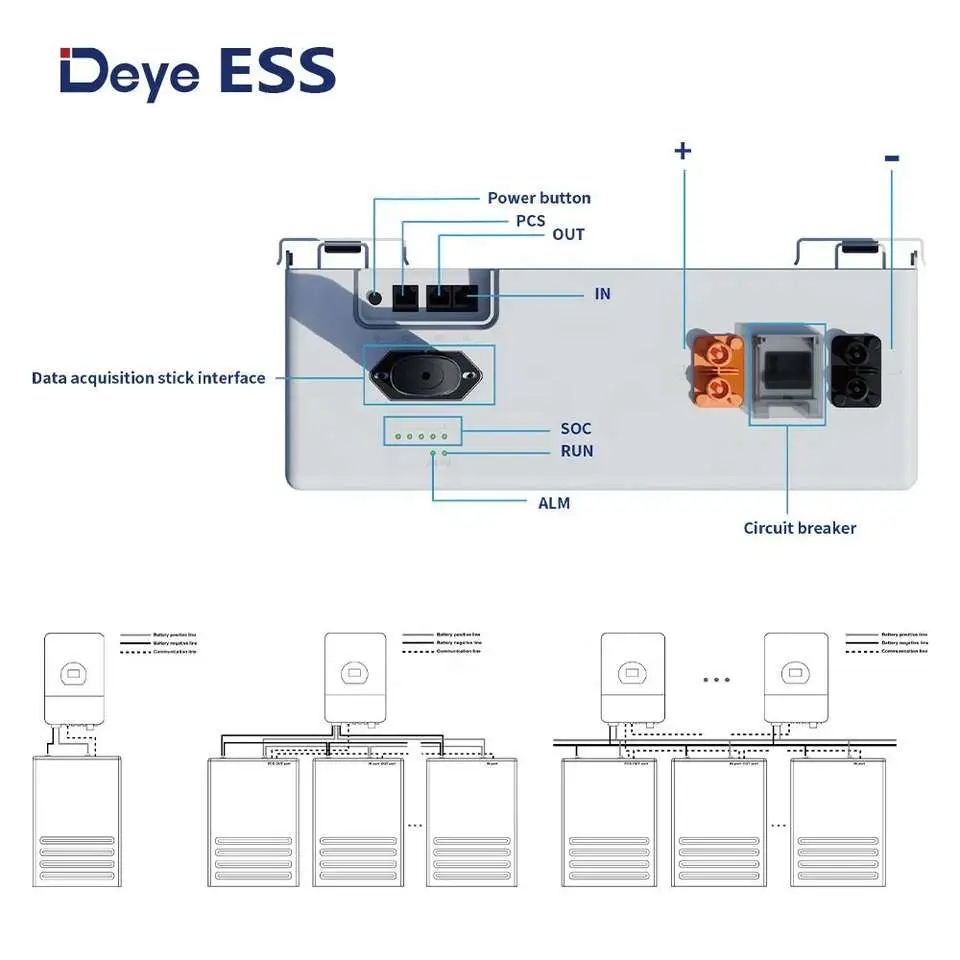
Five LED indicators on the front panel show state of charge and alarm status at a glance, no app required for a basic health check.
For deeper insight, the optional WiFi and Bluetooth data logger connects to the Deye app, giving you real-time monitoring, intelligent charge and discharge strategy, and AI-assisted data analytics from your phone.
Scalability: Growing With Your Energy Needs
One battery rarely stays one battery for long. Most of my clients start with a single unit and expand as their household or business grows.
The Deye 5kWh lithium battery supports up to 32 units in parallel in a standard configuration, roughly 164kWh combined, scaling to 64 units with an additional CAN-Box for a maximum combined capacity of around 327kWh.
That range covers everything from a single apartment to a full commercial energy storage deployment, without ever needing to change battery brand or chemistry midway through a project.
It can be installed stacked in clusters of six packs per cluster, with multiple clusters paralleled together, or individually wall-mounted, whichever suits your available space better.
Communication and Inverter Compatibility
The battery communicates with your inverter through CAN 2.0 or RS485 protocols, the industry standard for smart battery management in hybrid solar systems.
This lets the inverter read real-time state of charge, voltage, and fault data directly from the battery, rather than guessing based on voltage alone.
Deye inverters pair with this battery seamlessly, since both speak the same communication language out of the box.
If you are running a different inverter brand, confirm compatibility with your installer before purchase, mismatched communication protocols are one of the most common, and most avoidable, mistakes in solar battery installation.
Installing the Deye 5kWh Lithium Battery
Setup is refreshingly simple compared to older battery technology. The unit supports wall mounting, floor mounting, or stack mounting, so it fits a utility room, a garage wall, or a dedicated plant room equally well.
Quick-plug positive and negative terminals speed up the connection process considerably. A manual circuit breaker on the front panel lets you safely isolate the battery from your system during maintenance, a small detail that saves real time and effort during servicing.
Natural air cooling means no active fan and no extra noise in your home, a genuine point in its favour for indoor installations.
Real-World Performance in Nigerian Conditions
Heat is the enemy of most batteries sold in this market. The Deye 5kWh lithium battery is rated to discharge down to negative 20°C and up to 55°C, giving it a wide enough margin to handle the hottest Lagos afternoons without meaningful performance loss.
I have installed this unit in poorly ventilated utility rooms where ambient temperatures regularly climb past 35°C, and the battery management system has handled the thermal load without complaint.
That kind of resilience is exactly what you want from equipment that has to work every single day, whether the grid cooperates or not.
Pricing and Where to Buy
The Deye 5kWh lithium battery is currently priced at ₦1,200,000 on our shop, backed by its full 10-year manufacturer warranty.
Pricing on lithium battery technology shifts with exchange rates and global cell costs, so always confirm the current figure before committing to a purchase.
You can view full pricing, stock availability, and product images on the official Deye 5.1kWh Lithium Battery product page.
How It Compares to Other Battery Options
If you are still weighing lithium against a cheaper tubular bank, our detailed breakdown on lithium versus tubular batteries in Nigeria walks through the real five-year cost difference, not just the sticker price.
For a full system build around this battery, our guide on 5kVA solar system cost in Nigeria shows exactly how it pairs with a matching inverter and panel array for a 3-bedroom home.
And if your power needs extend beyond residential use, our guide to commercial solar battery storage in Nigeria explains how multiple Deye units scale into a full commercial energy storage solution.
Certifications and Safety Standards
Safety certification is not optional when lithium batteries sit inside an occupied home. The Deye 5kWh lithium battery carries UN38.3 transport safety certification, IEC 62619 industrial lithium cell safety certification, CE marking, and UL1973 and UL9540A ratings among others.
You can review the full technical requirements behind IEC 62619 directly through the International Electrotechnical Commission for a clearer picture of what that certification actually tests for.
For installation standards specific to Nigeria, NEMSA publishes the electrical codes every solar installer should be following, and COREN maintains the register of certified engineers qualified to sign off on your system.
Warranty and Long-Term Support
A 10-year manufacturer warranty backs the Deye 5kWh lithium battery, covering performance degradation, not just outright defects.
That distinction matters, since many cheaper batteries only guarantee against total failure, leaving gradual capacity loss entirely uncovered, and it is a major part of what justifies the ₦1,200,000 price tag over a cheaper, shorter-lived alternative.
Deye also publishes an energy throughput figure of 16MWh over the warranty period, a useful benchmark for calculating expected lifetime value against your actual daily consumption.
Who Should Choose This Battery
The Deye 5kWh lithium battery suits a 3 to 4 bedroom home running a fridge, television, fans, lighting, and a modest air conditioning load overnight.
It also works well as a starting point for a small office or shop looking to scale storage capacity over time without locking into a single, non-expandable unit.
If your daily energy use sits meaningfully higher, running multiple AC units or heavy workshop equipment, pairing two or more units in parallel gives you the headroom without changing battery chemistry or communication protocol.
Frequently Asked Questions
How many hours can a Deye 5kWh lithium battery power a home?
A Deye 5kWh lithium battery, at 5.12kWh of nominal energy, can power a fridge, lighting, fans, and a television for roughly 8 to 10 hours, depending on your actual appliance load and how heavily air conditioning factors into your evening routine.
Is the Deye 5kWh lithium battery compatible with any inverter?
It communicates best with inverters supporting CAN 2.0 or RS485 protocols, and pairs seamlessly with Deye hybrid inverters. Confirm compatibility with your installer before buying if you are running a different inverter brand.
How long does the Deye 5kWh lithium battery actually last?
Rated for over 6,000 cycles at 90 percent depth of discharge, this battery can deliver more than 16 years of service under daily cycling, backed by a 10-year manufacturer warranty covering performance degradation.
Can I expand my Deye 5kWh lithium battery system later?
Yes. The battery supports up to 32 units in parallel standard, or 64 units with an additional CAN-Box, scaling to a maximum combined capacity of 327kWh for growing residential or commercial energy needs.
How much does the Deye 5kWh lithium battery cost in Nigeria?
The Deye 5kWh lithium battery is priced at ₦1,200,000, backed by a 10-year manufacturer warranty. Pricing can shift with exchange rates and global cell costs, so always confirm the current figure with your installer before purchase.
Does the Deye 5kWh lithium battery need active cooling?
No. It uses natural air cooling with no active fan, keeping installation quiet and maintenance minimal, a genuine advantage for indoor residential installations where noise matters.
Sizing a Deye 5kWh Lithium Battery to Your Appliance Load
Getting the most from a Deye 5kWh lithium battery starts with knowing your actual daily energy draw, not guessing at it.
Here is a realistic load breakdown for a typical Lagos household running this battery alongside a matching hybrid inverter.
| Appliance | Wattage | Daily Hours | Daily Energy |
|---|---|---|---|
| Refrigerator | 150W | 24 hrs (cycling) | 1.8kWh |
| LED TV | 100W | 6 hrs | 0.6kWh |
| Ceiling fans (3) | 75W each | 8 hrs | 1.8kWh |
| LED lighting (10 points) | 10W each | 6 hrs | 0.6kWh |
| Router and modem | 20W | 24 hrs | 0.48kWh |
Add that up and you land comfortably within the 5.12kWh this battery delivers, a good fit for a household avoiding heavy motor loads like a full air conditioning unit overnight.
Add an inverter-type AC unit to the mix, and pairing two Deye 5kWh lithium battery units in parallel becomes the sensible move.
Maintenance Tips to Extend Battery Life
A lithium battery needs far less hand-holding than a lead-acid bank, but a few habits still go a long way toward protecting your investment.
Keep the installation area reasonably ventilated, even though this unit tolerates heat well, airflow still helps the battery management system work less hard over time.
Avoid installing it in direct sunlight where the enclosure surface temperature can climb well above ambient readings.
Check the LED indicator panel periodically for any alarm signals, and do not ignore a red ALM light, it usually points to a fault worth investigating before it becomes a bigger problem.
If you have the optional WiFi data logger connected, review the Deye app monthly to track state of charge trends and catch any gradual performance drift early.
Finally, avoid running the battery to zero charge repeatedly where avoidable. While the 90 percent depth of discharge rating gives you room to work with, consistently pushing right to the edge of that limit shortens cycle life faster than moderate, well-managed daily use.
Keep the battery firmware and app updated where the automated upgrade feature is enabled, Deye periodically rolls out improvements to charge management logic, and staying current ensures your unit benefits from the latest efficiency gains without any manual intervention on your part.
Final Thoughts From the Field
After installing this unit across dozens of Lagos homes and small businesses, my honest verdict is simple: the Deye 5kWh lithium battery delivers exactly what its datasheet promises, consistently, without the surprises cheaper alternatives tend to produce six months down the line.
If you are ready to move away from unreliable backup power, view the full product listing and current pricing here, or reach out to our team directly for a system sized around your actual household load.
Call or WhatsApp us on 0814 596 4127, or visit mindseyesolar.com to get started.