
Description
1.5 kVA Inverter With Battery Price: Our 1kVA 12V Lithium Solar Package
Quick answer: The 1.5 kVA inverter with battery price in Nigeria runs from about ₦650,000 for a basic tubular set to over ₦1,600,000 once panels are added.
Our 1kVA 12V lithium solar package costs ₦940,000 and already includes two 600W panels, a 200Ah LiFePO4 battery, and installation accessories.
If you are searching for a 1.5 kVA inverter with battery price, you probably want one simple thing. You want quiet, steady power without buying petrol every day.
We hear this question daily at our Ibeju Lekki office. Customers in Lagos, Abuja, and Port Harcourt want a clear number before they spend a kobo.
So this page gives you that number. It also shows what your money buys and where our package fits.
We will be honest about one detail. Our package is rated 1kVA, not 1.5 kVA. For many small homes and offices, that is enough. Below, we show you how to check.
What Is the Real 1.5 kVA Inverter With Battery Price in Nigeria?
Prices vary a lot because sellers bundle different parts. One seller quotes an inverter alone. Another quotes an inverter, a battery, and panels.
Here is what Nigerian retail listings showed for the 1.5 kVA inverter with battery price in 2026.
| Setup | Typical 2026 price | What you get |
|---|---|---|
| 1.5 kVA inverter only (basic hybrid) | ₦169,000 to ₦265,500 | Inverter, no battery |
| 1.5 kVA inverter and one 200Ah tubular battery | ₦650,000 to ₦750,000 | Basic backup, mostly grid charging |
| 1.5 kVA 24V inverter, two 220Ah tubular batteries, four 300W panels, controller | About ₦1,672,000 | Solar charging with lead-acid |
| Our 1kVA 12V lithium solar package | ₦940,000 | Inverter, 200Ah LiFePO4 battery, two 600W panels, accessories |
These figures come from retailer listings. The 1.5 kVA inverter with battery price moves with the exchange rate, so confirm it on the day you buy.
Why the 1.5 kVA Inverter With Battery Price Changes From Seller to Seller
Four things move the 1.5 kVA inverter with battery price the most.
First, battery type. Tubular batteries cost less today. Lithium batteries cost more today but last far longer.
Second, system voltage. A 12V system is simpler and cheaper to wire. A 24V system handles bigger loads.
Third, the charge controller. An MPPT controller pulls more energy from your panels than a basic PWM unit.
Fourth, what is included. Panels, mounting, cables, and breakers can add several hundred thousand naira.
Why a Low 1.5 kVA Inverter With Battery Price Can Cost You More Later
A cheap quote often leaves out panels or accessories. You then buy them separately and pay again.
Cheap tubular batteries also wear out quickly in Nigerian heat. Many buyers replace them within two to three years.
So compare the total cost over five years, not just the day-one 1.5 kVA inverter with battery price. We show that math further down.
1kVA vs 1.5 kVA: What Can Each Inverter Run?
The “kVA” number is not the same as watts. Most small inverters deliver about 80% of their kVA rating as real power.
That means a 1kVA inverter gives about 800W. A 1.5 kVA inverter gives about 1,200W. Always check the exact rating on the datasheet.
So the real question is simple. How many watts do you run at the same time? Answer that first, then compare each 1.5 kVA inverter with battery price.
| Appliance | Typical watts |
|---|---|
| LED TV (32 to 43 inch) | 50 to 100W |
| Decoder | 15 to 25W |
| Wi-Fi router | 10 to 15W |
| LED bulb (each) | 9 to 12W |
| Standing or ceiling fan | 50 to 75W |
| Phone charger | 5 to 20W |
| Laptop | 45 to 65W |
| Desktop computer with monitor | 100 to 200W |
| Network switch | 10 to 15W |
| Laser printer (while printing) | 300 to 500W |
Home Use Example
Take a small flat with one TV, one decoder, one router, six bulbs, two fans, and six phone chargers. Together they draw about 360W if everything runs at once.
That is less than half of what a 1kVA inverter can deliver. You do not need to pay the higher 1.5 kVA inverter with battery price for this load.
Small Office Example
Now take an office with two desktop computers and monitors, a router, a network switch, six bulbs, and one fan. Together they draw about 450W.
A laser printer adds 300W to 500W while it prints. That pushes the total close to 800W for a short time.
The fix is easy. Print when other heavy items are idle, or use laptops instead of desktops. If your office needs more headroom, we can size a larger system for you.
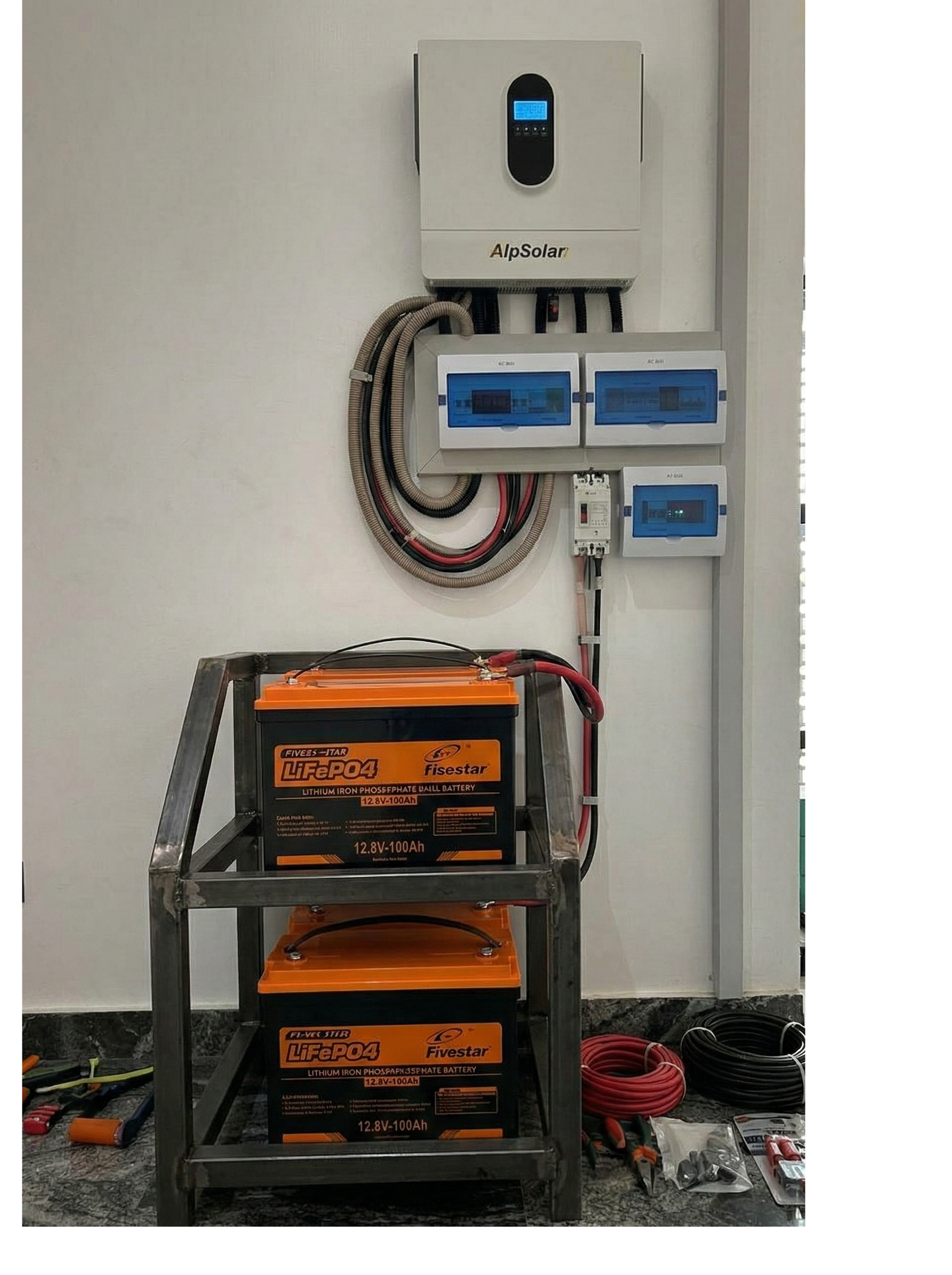
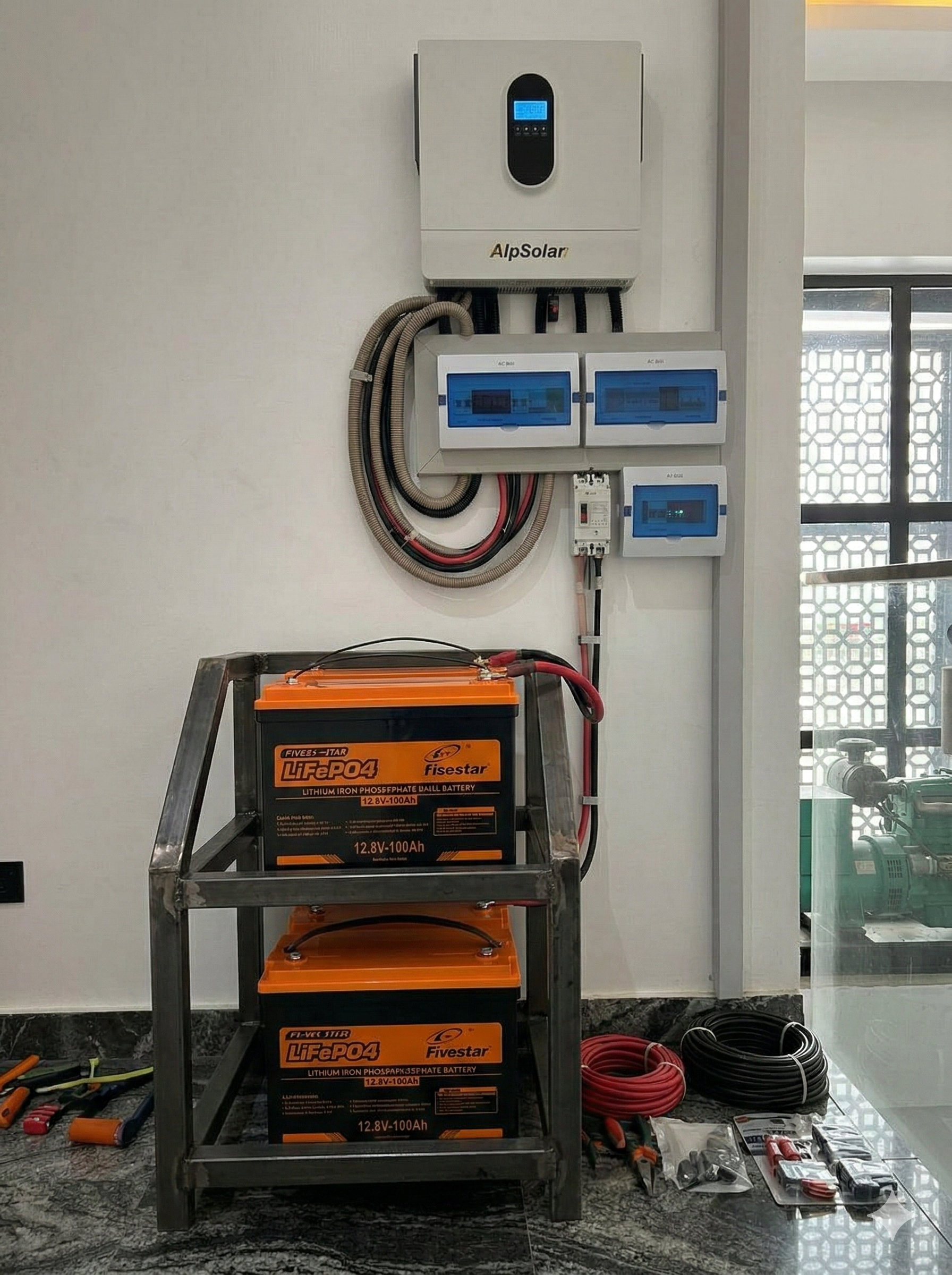
What Is Inside Our 1kVA 12V Complete Solar System?
Our team assembled this package so you do not chase parts across markets. Everything arrives together, matched, and ready to install.
| Component | Specification | Warranty |
|---|---|---|
| Inverter | 1kVA 12V pure sine wave hybrid, built-in MPPT controller, LCD display, auto changeover | 2 years |
| Battery | 12.8V 200Ah LiFePO4, 2.56kWh, built-in BMS protection | 3 years |
| Solar panels | Two 600W monocrystalline panels, 1.2kW total | 15 years product, 25 years linear performance |
| Accessories | Installation accessories included | Covered by the 2-year system warranty |
The Inverter
The inverter is a pure sine wave unit. That means clean power that is safe for TVs, laptops, and routers.
It has a built-in MPPT charge controller and an LCD screen. You can see battery level, solar input, and load at a glance.
Auto changeover switches between solar and grid without you touching anything. When NEPA takes the light, your essentials stay on.
The Battery
The battery is a 12.8V 200Ah LiFePO4 unit. Multiply those two numbers and you get 2,560Wh, or 2.56kWh of stored energy.
LiFePO4 is the safest common lithium chemistry. It handles heat well and does not need water top ups.
A built-in battery management system (BMS) guards against over-charging, deep discharge, and short circuits. We rate the expected lifespan at 7 to 8 years.
Want to see how lithium chemistries differ? Battery University explains the main lithium-ion types in plain language. You can also browse our 12.8V LiFePO4 battery listings.
The Solar Panels
You get two 600W monocrystalline panels. Together they form a 1.2kW array.
That is an oversized design on purpose. The array is bigger than the 2.56kWh battery needs.
This gives you three benefits:
- Faster battery charging on sunny days
- Better output on cloudy days
- Less reliance on a petrol generator
Want to understand panel pricing better? Read our guide on the cost of solar panels in Nigeria.
How Long Will the Battery Run?
Runtime depends on your load. The table below shows realistic estimates with no solar input, which is the worst case at night.
We assumed 90% usable battery capacity and 90% inverter efficiency. Real results vary a little with age and temperature.
| Load running | Estimated runtime |
|---|---|
| 100W (router, few bulbs, phone charging) | About 20 hours |
| 200W (TV, decoder, router, fan, bulbs) | About 10 hours |
| 350W (full home example above) | About 6 hours |
| 600W (office with printer idle) | About 3.5 hours |
| 800W (maximum load) | About 2.5 hours |
During the day, the panels feed the load directly and refill the battery. On a good sunny day the battery can recharge fully.
This is why a 1.2kW array matters. It keeps the battery topped up so evening power is ready when you need it. Most 1.5 kVA inverter with battery price quotes we see leave panels out entirely.
Lithium or Tubular? Compare Before You Pay
Most low quotes for a 1.5 kVA inverter with battery price use tubular batteries. That is where the savings come from. Let us compare them side by side.
| Feature | 12V 200Ah tubular | 12.8V 200Ah LiFePO4 |
|---|---|---|
| Energy stored | About 2.4kWh | 2.56kWh |
| Usable share | About 50% | 80% to 90% |
| Usable energy | About 1.2kWh | About 2.0kWh to 2.3kWh |
| Cycle life | 500 to 1,500 cycles | 3,000 to 6,000 cycles |
| Life in Nigerian heat | Often 2 to 3 years | 7 to 8 years rated |
| Maintenance | Water top ups for flooded types | None |
| Weight | Roughly 60kg | Roughly 25kg |
Look at the usable energy row. The lithium battery gives you nearly double the real energy from the same 200Ah label.
A tubular battery also fades faster when it is discharged deeply and recharged late. That happens often during long outages. So the cheapest 1.5 kVA inverter with battery price is not always the cheapest choice.
If you prefer a sealed lead-acid option, we also stock the Monbat 12V 200Ah AGM battery. It suits buyers with a tighter upfront budget.
For a deeper look at how lithium compares with other batteries, see our guide to complete solar packages in Nigeria.
How Fast Does This Package Pay for Itself?
Let us use a simple example. A small 1kVA petrol generator burns roughly 0.5 litres per hour at light load. Petrol has recently sat around ₦1,300 per litre at the pump.
Here are two common patterns.
| Generator use | Daily fuel cost | Monthly fuel cost | Payback on ₦940,000 |
|---|---|---|---|
| 5 hours per day | ₦3,250 | About ₦97,500 | About 10 months |
| 8 hours per day | ₦5,200 | About ₦156,000 | About 6 months |
This counts fuel only. It ignores oil changes, repairs, and the noise you no longer hear.
It also assumes the solar package replaces the generator for the loads it can carry. Heavy appliances such as air conditioners need a larger system.
Grid costs matter too. NERC tariff orders now place Band A customers well above ₦200 per kWh. Every unit of solar energy offsets an expensive unit. You can check current rates on the NERC website.
7 Proven Tips Before You Pay Any 1.5 kVA Inverter With Battery Price
We have seen buyers lose money on avoidable mistakes. Use this checklist before you accept any 1.5 kVA inverter with battery price.
1. Add Up Your Real Watts
List every appliance you run at the same time. Use the wattage table above.
Then add 20% for safety. That number tells you whether 1kVA or 1.5 kVA is right. It also tells you which 1.5 kVA inverter with battery price is worth considering.
2. Choose the Battery Chemistry First
The battery drives both the cost and the lifespan. Decide between lithium and tubular before you compare any 1.5 kVA inverter with battery price.
If you plan to keep the system for many years, lithium usually wins on total cost.
3. Ask for Usable Capacity, Not Just Ah
A 200Ah label does not tell you how much energy you can use. Ask for the usable share.
This one question exposes most weak quotes. A low 1.5 kVA inverter with battery price often hides a small usable capacity.
4. Confirm the System Voltage
Check whether the inverter is 12V or 24V. Your battery bank and cables must match it.
Mixing them causes poor performance or damage.
5. Check the Charge Controller and Panels
Ask if the controller is MPPT. Ask how many watts of panels the inverter accepts.
An inverter that cannot use your panels wastes your money, even at a low 1.5 kVA inverter with battery price.
6. Read the Warranty and Service Terms
Look for the warranty length on each part. Ask who repairs it and where.
Our policy includes remote diagnostics, free configuration support within one year, and repair or replacement of manufacturer-fault parts.
7. Insist on Proper Installation and Surge Protection
Bad wiring causes most system failures. Ask whether the 1.5 kVA inverter with battery price includes installation, and what the installer certifies.
Lightning damage without surge protection is excluded from our warranty. So we advise adding a surge protection device during installation.
Use a technician who follows the safety rules from NEMSA. For larger jobs, check the installer’s registration with COREN.
Installation, Safety, and Warranty Details
Every package ships in delivery-ready packaging for nationwide shipping. The condition is new, and we keep it in stock.
Our servicing obligation covers:
- Remote technical diagnostics
- Free configuration support within one year
- Repair or replacement of manufacturer-fault components
- On-site support across locations
It does not cover physical damage, electrical abuse, unauthorized tampering, or lightning without surge protection.
Standards matter for lithium batteries too. The IEC publishes the safety standards, including IEC 62619, that reputable lithium battery makers test against. Ask any seller which standards their battery meets.
Who Should Buy This Package?
This package suits you if your daily load stays under about 800W. That includes lights, fans, a TV, a decoder, a router, phone charging, and laptops.
It fits a one-bedroom flat, a small shop, a home office, or a security post. For these users, our package often beats the 1.5 kVA inverter with battery price on value. It also works for a student hostel room or a small clinic reception desk with light loads.
It does not suit you if you must run an air conditioner, freezer, pumping machine, or heavy kitchen appliances. For those loads, look at a bigger system.
Our 5kVA solar system cost guide shows what a family-home setup costs. For offices and larger homes, see our 10kVA complete solar package or the 20kVA complete solar package.
Payment and Financing Options
We know ₦940,000 is a real decision, just like any 1.5 kVA inverter with battery price. That is why we offer direct equipment financing plans with one point of contact.
Banks also offer solar loans. Check Access Bank’s Switch to Solar, FCMB’s Solar Energy Loan, and Fidelity Bank’s Green Energy Finance.
Read the terms carefully before you sign. Loan rates and requirements change from lender to lender.
How to Order
Ready to move? Ask us to compare our package with any 1.5 kVA inverter with battery price you have received. Here is the simple process.
- Call or WhatsApp us on 08145964127
- Tell us your appliances and your city
- We confirm the package fits your load
- You pay and we schedule delivery and installation
You can also visit us at Plot 4b Greenlite Estate, Ibeju Lekki, Lagos. Or email info@mindseyesolar.com.
Prefer to browse first? See the full Mindseye Solar shop, or read our pillar guide on the cost of solar power in Nigeria. To talk to an engineer, contact us for a free consultation.
The Bottom Line on the 1.5 kVA Inverter With Battery Price
A basic 1.5 kVA inverter with battery price starts near ₦650,000, but that price usually excludes panels and uses tubular batteries. Add panels and the total passes ₦1,600,000.
So judge every 1.5 kVA inverter with battery price by what it includes, not by the headline number.
Our 1kVA 12V package costs ₦940,000. It includes lithium storage, a 1.2kW solar array, and installation accessories.
If your load stays under 800W, you get clean, quiet power and a fast payback. If you need more, we will size a bigger system honestly.
Frequently Asked Questions
What is the 1.5 kVA inverter with battery price in Nigeria in 2026?
A basic 1.5 kVA inverter with one 200Ah tubular battery costs about ₦650,000 to ₦750,000. Adding solar panels pushes the total above ₦1,600,000. Prices change with the exchange rate, so confirm before paying.
How much does your 1kVA 12V solar system cost?
Our 1kVA 12V complete solar system costs ₦940,000, reduced from ₦1,250,000. It includes a pure sine wave hybrid inverter, a 12.8V 200Ah LiFePO4 battery, two 600W solar panels, and installation accessories.
Is a 1kVA inverter enough, or do I need 1.5 kVA?
A 1kVA inverter delivers about 800W of real power. If your appliances draw less than that at the same time, it is enough. Add up your watts first, then compare the 1.5 kVA inverter with battery price.
Can this system run a refrigerator or air conditioner?
We do not list a refrigerator or air conditioner among the supported loads. An air conditioner needs a much larger system. Ask us before buying if you need a small fridge.
How long does the lithium battery last?
We rate the 12.8V 200Ah LiFePO4 battery for 7 to 8 years of service. It carries a 3-year warranty. Lifespan depends on daily use, temperature, and how deeply you discharge it.
What does the warranty cover?
The inverter has a 2-year warranty and the battery has 3 years. Panels carry 15 years on the product and 25 years on linear performance. Physical damage, tampering, and unprotected lightning strikes are excluded.
Do you deliver outside Lagos?
Yes. We ship nationwide in delivery-ready packaging. We also provide remote diagnostics and on-site support across locations. Call 08145964127 to confirm delivery time for your city.
Is lithium worth the higher price over tubular?
For most daily users, yes. A lithium battery gives nearly double the usable energy from the same 200Ah label and lasts several times longer. That usually lowers your total cost, whatever the 1.5 kVA inverter with battery price.