
Solar Water Heater Price in Nigeria (2026): What You Should Know Before You Buy
Solar water heater prices in Nigeria in 2026 range from ₦450,000 to ₦1,800,000, depending on tank size and household needs. Here is a quick breakdown:
| Household Size | Tank Capacity | Price Range |
|---|---|---|
| 1 to 3 people | 100 to 150 litres | ₦450,000 to ₦680,000 |
| 4 to 6 people | 200 to 300 litres | ₦700,000 to ₦1,200,000 |
| Large homes or guesthouses | 300 to 500 litres | ₦900,000 to ₦1,800,000 |
A solar water heater uses evacuated tubes to absorb sunlight and heat water stored in an insulated tank, at zero running cost on sunny days. Hybrid models include an auxiliary AC heating ring that automatically heats up water during cloudy or rainy weather, so you always have hot water regardless of the season.
Most Nigerian families recoup the full cost of their system within two to three years through savings on electricity and generator fuel bills. Over a 10 to 15 year lifespan, total savings typically reach between ₦3,000,000 and ₦4,500,000.
The Problem with How Most Nigerians Heat Water
Let us be honest. Heating water in Nigeria is expensive, and it is getting worse.
If you are using an electric water heater, immersion boiling ring, or electric water kettle of any capacity at all, you already know what it does to your electricity bill every month. It runs on grid power, which in Nigeria means it is running on either an erratic PHCN supply or your generator. Either way, you are paying. And you are paying heavily.
The average Nigerian household spends between ₦15,000 and ₦40,000 every single month just to heat water; hotels, guesthouses, and restaurants spend way more than that, depending on facility/family size and usage. Over the course of a year, that is anywhere from ₦180,000 to ₦480,000 gone, and you have nothing tangible to show for it. No asset. No savings. Just hot water that costs you a small fortune.
Now multiply that by five years. You are looking at nearly ₦2,400,000 spent on heating water alone, using a method that ties you permanently to fuel costs, electricity tariffs, and the unpredictable Nigerian power grid. That is the reality for millions of households today, and most people do not even realise how much they are losing until they sit down and do the math.
The good news is that there is a smarter, more cost-effective way to heat water, and more Nigerians are waking up to it every year. It is called a solar water heater, and understanding the solar water heater price is the first step toward making a decision that will save you money for the next decade and beyond.
What a Solar Water Heater Actually Is and How It Works
Before we talk numbers, it helps to understand exactly what you are buying and why it works so well in a country like Nigeria.
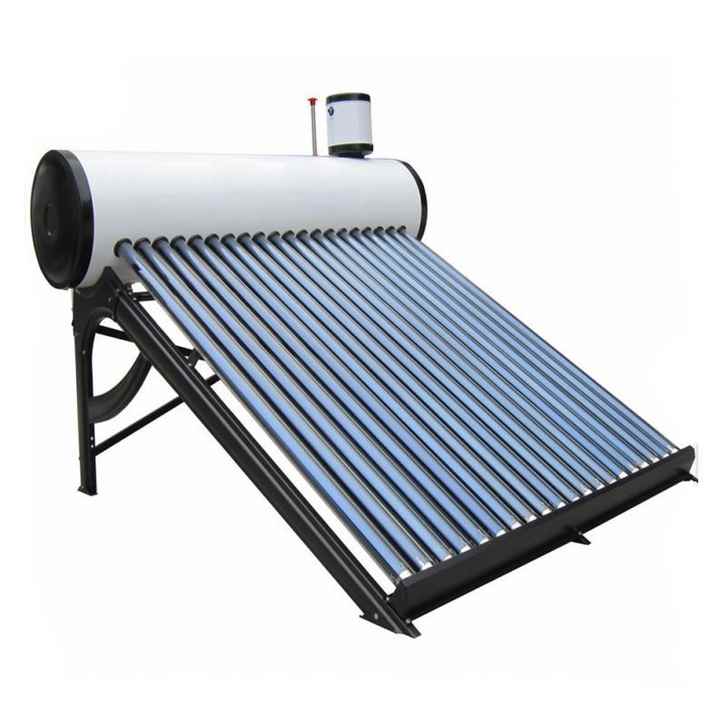
A solar water heater is a system that uses energy from the sun to heat water for household or commercial use. It typically consists of two main components: a solar collector, which absorbs sunlight and converts it into heat, and an insulated storage tank, which holds the heated water until you need it.
The most efficient type available today is the evacuated tube solar water heater. Each tube in the collector is made up of two layers of borosilicate glass with a vacuum sealed between them. That vacuum acts as an insulator, much like a thermos flask, preventing heat from escaping.
Sunlight passes through the outer glass layer, is absorbed by a special coating on the inner tube, and the heat generated is transferred to the water flowing through or around it.
Because of this vacuum insulation, evacuated tube systems can heat water even on cloudy days, because they respond to solar radiation rather than direct sunlight alone.
The heated water rises naturally into the insulated storage tank through a process called thermosyphon, where hot water moves upward, and cooler water flows down to replace it, creating a continuous circulation loop without the need for a pump in most residential systems.
The result is a tank full of hot water, ready when you need it, heated almost entirely by the sun at no running cost to you.
What is an Evacuated Tube Solar Collector and How Does it Work? (SolarSquare)
Now, Here Is Where It Gets Even Better: The Hybrid Model
One of the most common concerns people raise when considering a solar water heater is this:
What happens on rainy days?
What about during the harmattan season, when the sky is overcast for days at a time?
What if I have guests and the sun has not been strong enough to fully heat the tank?
These are fair questions, and they are exactly why the hybrid solar water heater exists.
Our system goes beyond the standard solar setup. It comes equipped with an auxiliary AC heating ring built directly into the storage tank. Think of it as a backup electric element that activates only when the solar energy collected has not been sufficient to bring your water to the desired temperature.
Here is why this matters. In a standard solar water heater, if the sun does not cooperate, you simply do not have hot water, or you have water that is only lukewarm. That is a real inconvenience, especially for families with children, the elderly, or anyone who depends on a reliable hot water supply.
With our hybrid model, that problem does not exist. The system automatically supplements solar heating with a small amount of electricity when needed, ensuring your water reaches the right temperature regardless of the weather.
On sunny days, which make up the vast majority of the year across Nigeria, the system runs entirely on solar energy and costs you nothing to operate.
On overcast or rainy days, the auxiliary ring kicks in briefly to top up the temperature, consuming far less electricity than a conventional heater would because the sun has already done most of the work.
The outcome is a system that gives you the best of both worlds: the free energy of the sun on good days, and the reliability of electric backup when the weather does not cooperate.
You are never left without hot water, and you are never paying full electricity rates to heat it from scratch.
This hybrid design is one of the key reasons why investing in a solar water heater in Nigeria makes more practical sense than in many other countries.
You are in one of the sunniest regions on earth. Your system will run on solar energy for well over 300 days of the year.
The auxiliary ring is simply your safety net for the remaining days, and it barely dents your electricity bill when it does run.
Solar Water Heater Price in Nigeria: What to Expect in 2026
Now, let us get to the question everyone asks first: what does a solar water heater cost?
The honest answer is that it depends on the size of your household and your daily hot water needs. Solar water heaters are sized by tank capacity, measured in litres, and choosing the right size is important. Too small and you run out of hot water. Too large and you are spending more than you need to upfront.
Here is a clear breakdown of what you can expect to pay in 2026 based on current market rates in Nigeria.
For Small Households (100 to 150 Litres)
Price range: ₦450,000 to ₦680,000
This size is ideal for one to three people. If you live alone, as a couple, or in a small apartment, a 100 to 150 litre system will comfortably meet your daily hot water needs. You will typically get enough heated water for two to three showers, dishwashing, and general household use each day.
For Family Homes (200 to 300 Litres)
Price range: ₦700,000 to ₦1,200,000
This is the most popular category and the most practical choice for the average Nigerian family of four to six people. A 200-litre system handles a family of four comfortably. See full specifications and pricing here
Step up to 250 or 300 litres if you have more people, multiple bathrooms, or if hot water usage in your home is on the higher side.
For Large Homes and Guesthouses (300 to 500 Litres)
Price range: ₦900,000 to ₦1,800,000
Large households with many occupants, homes with multiple bathrooms running simultaneously, or small commercial setups such as guesthouses, clinics, and salons fall into this category. At this scale, the savings from switching to solar are even more dramatic because the baseline electricity consumption being replaced is so much higher.
Is the Solar Water Heater Price Worth It? Let the Numbers Speak
Here is where the conversation shifts from cost to investment, because that is exactly what a solar water heater is.
Take the example of a family home with a 200-litre electric storage heater. Running that heater daily, factoring in generator fuel or electricity tariffs, costs most Nigerian families an average of ₦25,000 per month.
That is ₦300,000 per year. Over five years, that is ₦1,500,000 spent purely on heating water, with no assets created and nothing to show for it.
Now consider a 200 litre solar water heater at a purchase price of around ₦850,000. In under three years, that system has paid for itself entirely from the savings on your energy bill.
From year three onward, every single month of hot water is essentially free. And these systems are designed to last between 10 and 15 years with minimal maintenance.
The long-term savings are not marginal. They are transformational. A family that installs a solar water heater today and maintains it properly will save between ₦3,000,000 and ₦4,500,000 over the life of the system compared to continuing with conventional electric heating. That is money that stays in your pocket.
Beyond the personal savings, consider the fact that electricity tariffs in Nigeria have been rising consistently and show no signs of reversing.
Every increase in the electricity tariff makes your solar water heater more valuable, because the savings it delivers grow in proportion to what you are no longer paying.
What Affects the Final Solar Water Heater Price You Pay
The price ranges above are a reliable guide, but a few factors influence exactly where your quote will fall within those ranges.
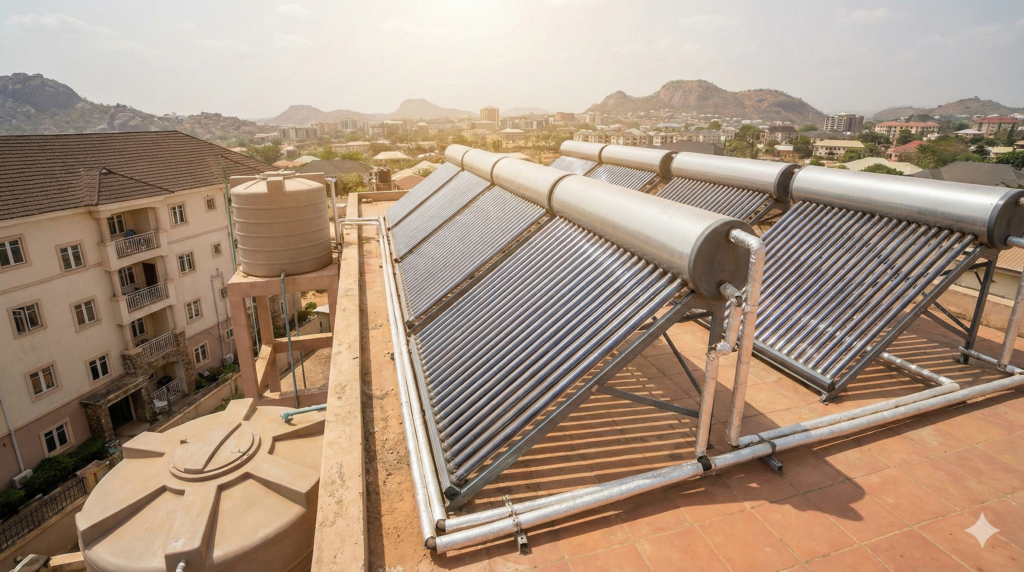
The type of collector matters. Evacuated tube collectors, which are the most efficient and the type we recommend and supply, sit at the higher end of the market because they outperform flat plate collectors in terms of heat output, performance on cloudy days, and long-term durability.
Installation complexity also plays a role. A straightforward rooftop installation on a single-storey building costs less than a system fitted on a multi-storey structure requiring longer pipe runs, additional insulation, or structural support work.
Brand and warranty are important considerations, too. A system from a reputable supplier with a solid warranty, genuine components, and after-sales support will cost more than a cheap alternative with no backup if something goes wrong. In the long run, the quality option is always cheaper because you avoid replacement costs and system failures.
Finally, the inclusion of the auxiliary AC heating ring, as featured in our hybrid model, adds a modest cost to the system but delivers a disproportionately large benefit in terms of reliability and peace of mind. It is an addition that pays for itself the first time the harmattan clouds roll in, and your water is still hot.
Making the Switch: What to Do Next
If you have read this far, you already know that the question is not really whether a solar water heater is worth it. The question is which size is right for your home and when you want to start saving.
Here is a simple way to think about it. Count the number of people in your household. If it is one to three, start with the 150 litre range. If it is four to six, the 200 to 250 litre range is your sweet spot. If you have a larger household or run a small commercial operation, look at 300 litres and above.
Once you have your size in mind, the next step is speaking with a supplier who can assess your roof orientation, available sunlight, and plumbing setup to confirm the right configuration for your specific home.
Not sure which size is right for your home? Our team will assess your household size, roof orientation, and daily hot water needs and recommend the best system for you at no charge. Book a free consultation today.
Book a free consultation today
The solar water heater price you pay today is not a cost. It is a one-time investment that eliminates one of the most persistent drains on your household budget, month after month, for the next decade and a half. The sun is already shining. The only question is whether you are using it.