
Lithium-ion-battery-prices-in-Nigeria in 2026 range from ₦1.5 million to ₦8.3 million, depending on capacity, brand, warranty, and battery management system quality.
A standard 16kWh LiFePO4 battery suitable for a 3-bedroom home typically costs between ₦1.9 million and ₦3.9 million. Prices fluctuate with exchange rates and local availability.
Your Complete Guide to LiFePO4 Batteries for Solar Homes in Nigeria
If you live in Nigeria, you know the challenges: frequent power outages, high fuel consumption from generators, rising electricity bills, and concerns about disturbing neighbors.
When considering solar, the key questions are which battery to choose and the cost in Naira.
This guide addresses those questions by detailing lithium-ion battery prices in Nigeria for 2026, reviewing the seven leading options available, and providing the information you need to make an informed purchase.
The good news is that lithium iron phosphate (LiFePO4) batteries have transformed what solar power can do for Nigerian homes. These are no longer luxury items reserved for wealthy households in Lekki or Maitama.
Prices have dropped significantly, warranties have improved, and local vendors in Lagos, Abuja, and Port Harcourt now stock most of these brands.
By the time you finish reading this guide, you will know which battery offers the best value for your budget, how to calculate the right capacity for your home, and where to buy a genuine product without getting ripped off.
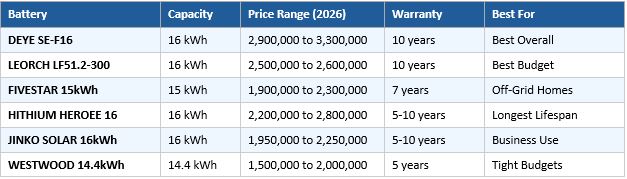
Quick Comparison: Top 6 Lithium Batteries in Nigeria at a Glance
Why Lithium Batteries Are the Best Choice for Solar in Nigeria
Nigeria’s Unique Energy Reality
There is no polite way to say this: the Nigerian power grid is one of the most unreliable in the world.
With an installed capacity often cited around 13,000 megawatts and actual generation frequently falling far short, blackouts can last anywhere from a few hours to multiple days in some states.
Diesel generator costs have surged following fuel subsidy removal, and the naira depreciation means importation costs keep pushing electricity-related expenses higher.
This is precisely why solar with lithium battery storage is not just a luxury in Nigeria. For millions of homes and businesses, it is quickly becoming the most practical path to energy independence.
Lithium vs. Lead-Acid: Why Nigerians Are Making the Switch
If you have run a home inverter system before, you are probably familiar with lead-acid batteries.
They are the heavy, bulky ones that corrode, need water top-ups, and die within two to three years if you are lucky.
Lithium iron phosphate batteries are a completely different technology.
Here is the key difference: a quality LiFePO4 battery lasts 6,000 cycles or more at 80 to 100 percent depth of discharge. That translates to roughly 10 to 15 years of daily use.
A typical lead-acid battery gives you maybe 500 to 800 cycles at 50 percent depth of discharge before capacity falls off a cliff.
Over 10 years, you might replace your lead-acid battery three or four times.
Each replacement costs money, time, and hassle. When you account for the total cost of ownership, lithium batteries almost always win.
There are also practical advantages for Nigerian conditions, specifically. LiFePO4 batteries are thermally stable, meaning they handle Nigeria’s high ambient temperatures far better than lithium cobalt or ternary lithium chemistries.
They do not emit gas, so they are safer to install indoors without heavy ventilation.
They are significantly lighter than lead-acid equivalents, making installation and handling easier.
The Climate Factor: How Heat Affects Your Battery Choice
Nigeria’s average temperature across the southern and middle belt states commonly ranges between 25 and 35 degrees Celsius, with northern states reaching even higher during the dry season.
This matters enormously for battery performance. Most of the LiFePO4 batteries reviewed in this guide are rated for operation between minus 20 and 55 degrees Celsius, giving you a generous safety margin even in Maiduguri in April.
Always ensure your battery installation is ventilated. Direct sunlight on the battery casing will reduce performance and lifespan regardless of chemistry.
We will cover installation best practices later in this guide.
What to Look for When Buying a Lithium Battery for Solar in Nigeria
Before we get into the reviews, it is worth understanding what the specifications on the box actually mean for your real-world experience.
Many Nigerians get burned by focusing only on price or brand name without looking at the numbers that truly determine whether a battery will serve them well.
Capacity: kWh vs Ah, and How to Size Your System
Capacity tells you how much energy the battery stores. You will see it expressed in kilowatt-hours (kWh) or ampere-hours (Ah).
A 16 kWh battery at 51.2V is same as a battery with roughly 314 Ah. The kWh figure is more useful for planning, because your appliances are rated in watts or kilowatts.
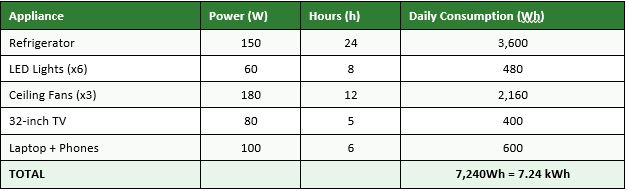
A typical Nigerian three-bedroom flat running a refrigerator, a television, fans, lights, and a phone-charging setup for 12 hours will consume approximately 5 to 8 kWh per day.
A 16 kWh battery gives you comfortable coverage with room to spare, even accounting for depth-of-discharge limits.
Voltage Compatibility
Most modern lithium solar batteries in Nigeria operate at 48V or 51.2V systems. Some older or budget inverter setups run at 24V or 12V.
Always confirm that the battery voltage matches your inverter before purchasing. Mismatching voltage is a common and costly mistake.
The batteries in this review are primarily 48V to 51.2V systems, which are the most efficient for home solar use today.
Depth of Discharge (DoD)
DoD refers to how much of the battery’s total capacity you can actually use. A battery rated at 80 percent DoD means you should not discharge below 20 percent of its total capacity.
A battery with 100 percent DoD, like the Leorch LF51.2-300, means you can use every kilowatt-hour stored. Higher DoD gives you more usable energy from the same battery size.
Cycle Life
A cycle is one full charge and discharge. If a battery is rated at 6,000 cycles at 80 percent DoD and you cycle it once per day, you are looking at over 16 years of life.
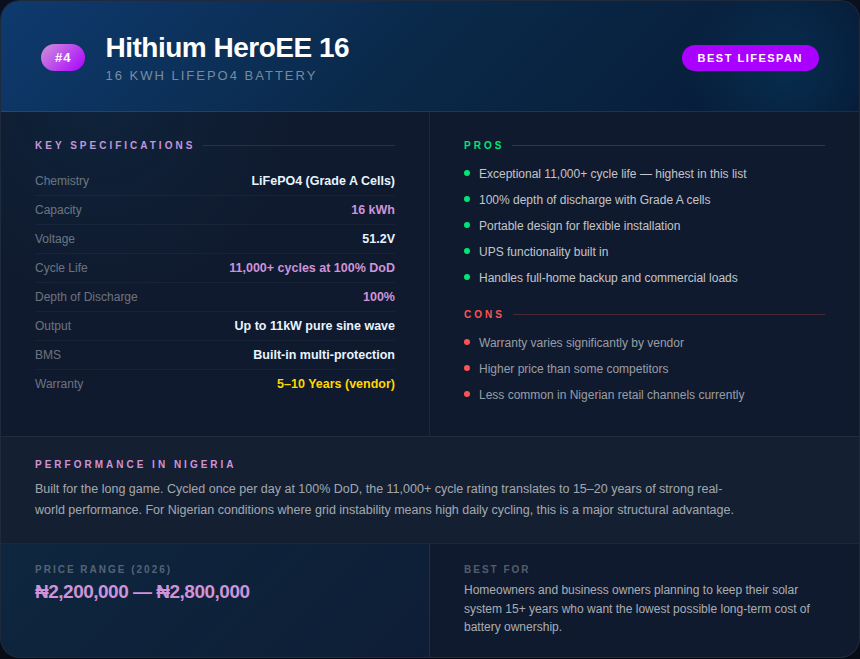
Some premium batteries like the Hithium HeroEE 16 are rated at 11,000 cycles or more, which is extraordinary by any measure. Higher cycle counts mean fewer replacements and lower long-term costs.
Battery Management System (BMS)
The BMS is the brain of the battery. It handles protection against overcharging, over-discharging, short circuits, and overheating.
A weak BMS is the primary reason budget batteries fail prematurely in Nigerian conditions.
When comparing batteries, look for active balancing BMS, not just passive.
Active balancing extends cell life and maintains performance over time.
Brand Reputation and Local Warranty Support
This is critical in the Nigerian market. A 10-year warranty is worthless if the vendor closes down or the manufacturer has no local service presence.
We recommend buying from established solar vendors in Lagos, Abuja, or Port Harcourt who carry genuine stock and can handle warranty claims locally.
We highlight Mindseye Solar as a trusted source throughout this guide.
Certifications to Look For
Genuine batteries should carry certifications such as CE, UL, IEC 62619, and UN38.3 for transport safety.
These certifications indicate that the battery has been tested by independent laboratories.
If a vendor cannot provide a datasheet or certification documents, be very cautious.
Top 6 Best Lithium Batteries for Solar in Nigeria
Use this table to quickly compare the most important specifications across all six reviewed batteries.
Prices are approximate 2026 Naira figures based on current market rates and will fluctuate with exchange rates.



Head-to-Head Comparison Table
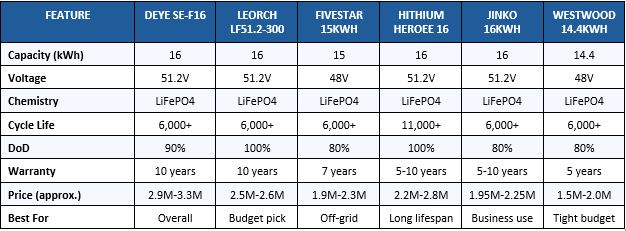
Use this table to quickly compare the most important specifications across all six reviewed batteries.
Prices are approximate 2026 Naira figures based on current market rates and will fluctuate with exchange rates.
How to Calculate the Right Battery Capacity for Your Nigerian Home
One of the most common mistakes Nigerians make when going solar is either oversizing or undersizing their battery bank. Both are costly.
Here is a simple step-by-step method to figure out exactly what you need.
List Your Appliances and Their Wattage
Write down every appliance you want to power from your solar battery.
For each one, note its power rating in watts (usually printed on a label on the device or in the manual) and how many hours per day you use it
Calculate Daily Energy Consumption
Multiply each appliance’s wattage by its daily hours of use. Add all the results together.
This gives you your total daily consumption in watt-hours (Wh). Divide by 1,000 to get kilowatt-hours (kWh).
Apply the Formula
Battery Capacity Needed (kWh) = Daily kWh Consumption divided by your battery’s Depth of Discharge (as a decimal)
For example, if your home consumes 8kWh per day and your battery has 90% DoD, you need: 8 divided by 0.9 equals 8.9kWh of nominal battery capacity.
A 16kWh battery gives you excellent headroom.
With 7.24 kWh daily consumption and a 90% DoD battery, you need 7.24 divided by 0.9, which equals 8.04 kWh of nominal capacity.
A 16 kWh battery gives you two days of autonomy, which is excellent protection against two consecutive days without sun or grid availability.
Real-World Example: A Lagos 3-Bedroom Flat
With 7.24 kWh daily consumption and a 90% DoD battery, you need 7.24 divided by 0.9, which equals 8.04 kWh of nominal capacity.
A 16kWh battery gives you two days of autonomy, which is excellent protection against two consecutive days without sun or grid availability.
Recommended Battery Bank Sizes by Home Type
- Single room or bedsitter: 5 to 8 kWh nominal capacity
- 1-to-2-bedroom apartment: 8 to 12 kWh nominal capacity
- 3-bedroom flat: 12 to 16 kWh nominal capacity
- Duplex or large home: 16 to 32 kWh nominal capacity
- Small office or SME: 16 to 50 kWh nominal capacity
Where to Buy Lithium Batteries for Solar in Nigeria
Buying the right battery from the wrong vendor is almost as bad as buying the wrong battery entirely.
Nigeria has a significant counterfeit solar products problem, particularly for batteries, where substandard cells are often repackaged in convincing boxes with fake certification stickers.
Our Top Recommended Vendor: Mindseye Solar
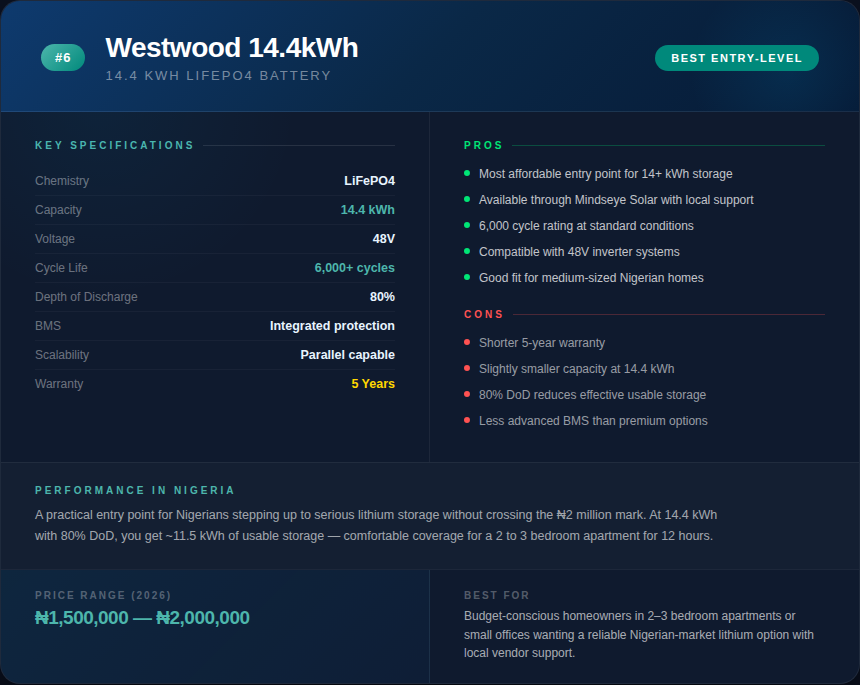
Mindseye Solar is one of Nigeria’s most trusted solar equipment vendors, stocking genuine lithium batteries, including the Deye, Westwood 14.4kWh, and Fivestar range.
They provide proper documentation, local warranty support, and technical guidance. Whether you are in Lagos, Abuja, or Port Harcourt, Mindseye Solar can ship nationwide.
Always confirm stock availability and pricing directly with them, as prices fluctuate with exchange rates.
Tips to Avoid Counterfeit Batteries in Nigeria
- Always request a datasheet and certificate of conformity before purchase.
- Scan any QR code on the battery casing to verify authenticity on the manufacturer’s website.
- Avoid deals that are significantly below market price. A 16 kWh LiFePO4 battery priced under 1.5 million naira in 2026 should trigger immediate scepticism.
- Buy from vendors who offer a genuine local warranty with a physical address, not just a WhatsApp number.
- Ask to see the battery before payment if buying in person, checking for any physical damage or unusual heat from the casing.
Installation Tips and Maintenance for Nigerian Conditions

Ventilation and Location
Even though LiFePO4 batteries do not emit gas like lead-acid batteries, they still perform best in a cool, well-ventilated space.
Avoid installing your battery bank in a room that gets direct sun exposure through windows, in an enclosed space with no airflow, or directly on concrete floors without a wooden or rubber baseboard to prevent moisture absorption.
The ideal installation temperature for most batteries in this review is between 15 and 35 degrees Celsius.
In northern Nigerian states where temperatures can exceed 40 degrees C during the dry season, consider an insulated enclosure or a room with a small fan for air circulation.
Pairing with the Right Inverter
In Nigeria, the most common hybrid inverter brands are Deye, Growatt, SRNE, Victron Energy, and Solix.
Most of the batteries in this review use standard CAN bus or RS485 communication protocols, making them compatible with all of these brands.
The Deye SE-F16 works most seamlessly with Deye hybrid inverters, unlocking monitoring and remote firmware update features.
The Leorch, Fivestar, and Westwood batteries are designed to be brand-agnostic.
Charge Controller Settings
Incorrect charge settings are the single most common cause of premature lithium battery failure in Nigeria.
Your charge controller or hybrid inverter must be set to the correct charge voltage for your specific battery.
For a 51.2V LiFePO4 battery, the typical bulk charge voltage is 57.6V, and the float voltage is around 54V.
Always follow the manufacturer’s datasheet for your exact model rather than using generic lithium settings.
Basic Maintenance Checklist
- Check battery terminal connections every 6 months for corrosion or looseness.
- Monitor BMS alerts through your inverter’s app or display panel.
- Keep the battery surface clean and dry. Wipe with a dry cloth only.
- Do not store the battery at less than 20 percent charge for extended periods.
- After a power outage lasting more than 3 days, do a full charge before resuming normal operation.
- Register your warranty with the manufacturer or vendor within 30 days of purchase.
Our Recommendations
Nigeria’s energy future is solar, and lithium iron phosphate batteries are the storage technology that makes solar reliable enough to count on.
We have walked you through everything from understanding lithium-ion battery prices in Nigeria to calculating your home’s exact storage needs, reviewing the top seven batteries on the market, and showing you where to buy them safely.
Here is our quick summary of who should buy what:
- Best overall value: Deye SE-F16 at NGN 2.9 to 3.3 million. If you can stretch the budget, the 10-year warranty and advanced technology make it the most cost-effective long-term choice.
- Best budget LiFePO4: Leorch LF51.2-300 at NGN 2.5 to 2.6 million. Grade A cells, 100% DoD, and a 10-year warranty at a price that undercuts the Deye significantly.
- Best for off-grid or large homes: Fivestar 15kWh at NGN 1.9 to 2.3 million. A solid 48V option for anyone with a large home or existing 48V inverter system.
- Best for businesses: Jinko 16kWh at NGN 1.95 to 2.25 million. International certification credentials and brand recognition make this the go-to for commercial applications.
- Best lifespan: Hithium HeroEE 16 at NGN 2.2 to 2.8 million. The 11,000+ cycle rating is in a class of its own for buyers thinking 20 years ahead.
- Most affordable entry point: Westwood 14.4kWh at NGN 1.5 to 2 million. A practical first step into lithium solar storage available through Mindseye Solar with local support.
One final thought: do not let perfect be the enemy of good.
If you have been running a generator for five years and spending NGN 80,000 to 150,000 on fuel every month, even the most affordable battery in this list will pay for itself within two to three years.
The question is not really whether you can afford to switch to solar lithium storage. It is whether you can afford to keep waiting.
If this guide helped you, please share it with someone in your network who is still on the fence about solar.
And if you have questions about your specific home setup, drop them in the comments below, and we will do our best to answer.